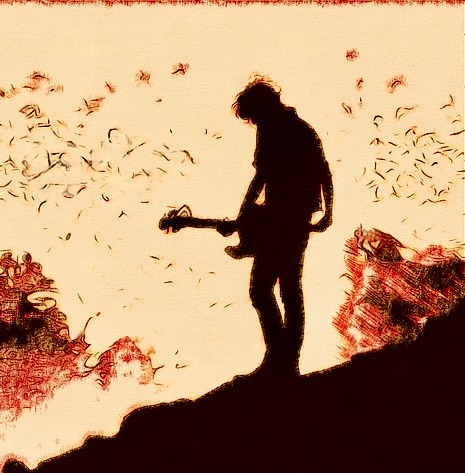
I don’t run around with no mob
Got myself a little job
I’m going to buy me a little car
Drive my girl in the park
Don’t bother us, leave us alone
Anyway we almost grown
— Chuck Berry, “Almost Grown,” 1959
If we are lucky, we experience a period in our lives when we only believe we are adults.
This time may come in college or in its afterglow, and while we’re in it it might seem terrible. We might have little or no money. We might be anxious about our prospects for ever finding a proper place in society. We might fear never finding someone who could love us while knowing us at our most frightened and shame-ridden.
We might have a low-stakes job, a shabby apartment, a few nice things, but maybe we still do our laundry at our folks’ house. If we live in another town or city or state or another country halfway around the world, we still know we can call them if things slide sideways. Even if you never avail yourself of this option, knowing that you could at least ask for help is a species of privilege. Having somewhere to run is a luxury, not a birthright.
For most of human history, young men have served as cannon fodder. We were expendable, a herd that needed to be thinned for economies to keep humming along. Sometimes I think war was invented for young men to have something to do. War also eases the pressure on old men looking for second and third wives.
I was born too late for Vietnam, coming of age after the draft ended. I didn’t have to choose between Canada and southeast Asia. I was part of a lucky generation. I just didn’t know it.
In 1984, almost all my friends were post-collegiate unsettled and poor. We were almost grown. We lived in rent houses. We never imagined how we might escape into the middle-class lives our parents expected us to adopt.
Maybe it was better then than it is for similarly situated young people today. Jobs were not hard to come by. They generally paid a living wage. I was a cop reporter who reviewed records and concerts on the side; I had a couple of regular freelance gigs. I went to work at 3:30 a.m, Sunday through Thursday, prowling a city that averaged more than a murder a day.
My schedule allowed me vampire hours. I slept in the afternoon. I was usually up and out after dark. I went to clubs along Shreveport’s Kings Highway, like the Blarney Stone, the Rusty Nail, and the Killer Poodle. I also visited clubs in Shreve Square, mostly Humphrees, though there was a cavernous club called the Cotton Exchange for a while. Availability is an ability, the sports writers say, so maybe that was why Eddie approached me about starting a band.
My credentials were not great. I had won a national songwriting contest while in college. This gave me the opportunity to perform on “The Merv Griffin Show” and to play a couple of songs in a Nashville steak house before the headliner, a up-and-comer who had just released his first album named Lee Greenwood, took the stage. I also played solo in fern bars where nobody really listened. I had been onstage a few times with Eddie on bass. My old songwriting partner had recently decamped to Florida to play piano in a resort bar. I had a shaky tenor that was close enough for rock ’n’ roll and knew all four guitar chords. I still don’t know why Eddie considered me the essential front man.
But anyway, it was Eddie’s band. He recruited the others. I didn’t know them from before. Jimmy and Linda were a married couple. He played guitar and she played keyboards. She had a pure crystalline timbre to her voice, which she insisted be limited to backing vocals. Tony was a slightly older Black guy. I’m changing his name because of what happened to him afterward. He was our drummer, though he could play anything. He also sang lead in a soul group, his other band. I came to our first practice in Eddie’s meager living room. I brought a spiral notebook full of songs, a deep-bowled Ovation, and a Tokai Stratocaster knock-off.
I didn’t have an amp. I’m not sure I had a cable.
■ ■ ■
It was not terrible, though I was scared to death.
I played a few of my songs. Eddie already knew most of them. The rest of the band fell in behind me with a startling propulsive power. Jimmy was very good. He was one of those instinctive musicians who could dig down into the guts of a song. He would pull out all manner of springs and sprockets, discard what was unnecessary, and shine up the rest. Then, he would slip them back in place. He was like a mechanic rebuilding an engine as the car rolled down the road at 80 mph.
Whenever we’d slide to a stop during practice he’d spontaneously break into a snippet of “Crazy Train.” Sometimes, he’d play Eddie Van Halen’s “Eruption.” Other times, he’d choose Van Halen’s version of “You Really Got Me.” Occasionally, he performed Isaac Albéniz’s “Asturias (Leyenda)” movement from “Suite española, Op.47.”
I’ve since met a lot of players who can do this. He was the first guitarist I ever knew who could listen to a piece of music once. He could then immediately play it back in its entirety.
Tony was our other virtuoso — the best musician in the band. One of our set pieces had Eddie and me walking offstage while Jimmy and Tony thrashed on. Then Tony would throw down his drumsticks, pick up my Tokai and trade guitar solos with Jimmy. Eddie would climb behind the drums and Linda would lay down the bass line on her Fender Rhodes. I’d come back and we’d swing into either the Rolling Stones’ “Miss You” or T. Rex’s “Get It On (Bang a Gong).”
I would always get lost on “Get It On.” I still can’t figure out the song’s phrasing. We worked that confusion into the act. I smile when I’m nervous. I laugh when I’m afraid. We could put the song over most of the time. I don’t ever remember it completely collapsing. That might be my memory being merciful.
My songs made up the bulk of our material — probably 80%. They were wordy and odd, not quite love songs, and most of them make me wince today. But I still play a couple of them.
Eddie arranged a hardcore punk version of Hank Williams’ “Your Cheatin’ Heart.” It always got the biggest reception when we played live. He had a couple of other country songs he similarly abused. Sometimes I played and sang Bruce Springsteen’s “Thunder Road” on my acoustic by myself. Other times, Linda joined me. She dropped piano chords over my tentative vocal. Her soaring harmonies lifted it up.
Not too long ago I found a tape of myself performing “Thunder Road” live in a club. It sounded strange to me. My voice has darkened and deepened. In many ways, I think I’m a better singer now. But there is a certain quality to that recording, a vulnerability that, at the time, I probably loathed. But it was nothing to be ashamed of. Sometimes, when I think about those days, I think we could have been very good.
■ ■ ■
We had a little success.
Tom Ayres — who brought David Bowie to RCA Records — became our manager. Ayres had let the young Bowie stay with him in his Hollywood Hills home. At that time, Bowie was still known as David Jones. The home was a mansion formerly owned by silent-movie actress sisters Lillian and Dorothy Gish. Tom was one of those essential behind-the-scenes record company guys; in his career he worked for Hanna-Barbera Productions, ABC Records, Columbia Records, United Artists, Kama Sutra Records, and Buddha Records, as well as RCA.
Originally from rural Sabine Parish, Louisiana, Ayres settled in California after a stint in the Army Air Corps. He played bass in Johnny Burnette’s Quintet and produced acts like Jay and the Americans. He worked with the Sir Douglas Quintet. He’d managed Gene Vincent.
Then he convinced Bowie to sign with RCA. The “Major Tom” in Bowie’s “Space Oddity” may be a reference to him. Ayre’s in the Rockabilly Hall of Fame. He was very close to legendary Los Angeles DJ Rodney Bingenheimer; he told us he could get anything played on Bingenheimer’s show on KROQ.
I met Tom after he’d moved back to his home state; he was working with Dale Hawkins, the cousin of Ronnie Hawkins, the guy who wrote and sang “Suzie-Q.”
He’d heard about me winning my contest, and I played him some songs. He arranged for me to recording five of them, solo acoustic, as demos. The recording engineer didn’t think my voice was strong enough to carry the songs. I agreed with him. Tom didn’t think they were the sort of thing a Nashville combine would be interested in. I agree with that too. So we tabled the project.
But after Eddie put the band together, I invited Tom to a rehearsal.
I don’t think we ever signed anything. He booked us some studio time. He also arranged for us to shoot a video.
■ ■ ■
The recording went well; we knocked out a couple of songs in a couple of hours. I was nervous singing, so Linda stood behind the glass in the control room and sang with me. I could watch her and know when to come in. Tom brought in Danny Johnson. Danny was a local guitar hero who was then in Rod Stewart’s band. He overdubbed a second guitar solo over what we considered the “A” side. He used my Tokai, and nailed it in two takes.
Then he asked if he could buy the guitar from me. I think he gave me two hundred dollar bills and took it home that night. I miss that guitar.
We didn’t press any vinyl but we sent out tapes. Here and there radio stations played one or both of the songs. Somewhere I still have a cassette recording of an air-check of Bingenheimer introducing our songs on his show.
Our video shoot did not go as well. We rented a theater in downtown Shreveport. We invited everyone we knew to watch us. We lip-synced our two songs again and again.
Before the shoot, Tom had set us up for hair and makeup. The stylist who got ahold of me teased my hair straight up a la Billy Idol. I grinned at her and told her I liked it but as soon as I got to my car I mussed it up and pressed it down, trying to mold it back into something that looked, or at least felt, more like me.
I almost got it into acceptable shape when we walked out on stage. It was poofy but I didn’t look like a New York Doll. I walked to the mic stand and looked down at the crowd. There, front and center, two feet from the lip of the stage, stood my stylist. Her arms were folded. Her eyes were drilling holes in my skull. She didn’t move all night as we did take after take and our friends and family jumped around acting like we pretenders were blowing them away with our maximum rock ‘n’ roll.
■ ■ ■
I think the video ended it for me.
I was embarrassed by it — I looked like (because I was) a poseur.
We were not glam rockers. We were not anything really. My songs were both earnest and snide. They were relatively free of swagger. I wanted a more acoustic, organic sound — Jimmy and Linda wanted to rock harder in a mainstream vein. Eddie had his retro tendencies; Tony brought the funk. It could have worked, but I was the weakest link and couldn’t hold it together.
It was fun, but it was also scary being up on stage. I never got over the feeling that the band behind was bearing down on me like a tailgating tractor trailer.
And it wasn’t getting better for me. While the band became more fluid and locked together. I felt more and more exposed and vulnerable. I didn’t think I could keep up.
So we played an outdoor showcase at the Red River Revel, got paid a little, and I walked away. Maybe nine months after Eddie had convened us in his living room, it was over. My work just won’t allow this any more, I told them. Best of luck.
They took it in stride. They wandered off to other bands. Jimmy and Linda got divorced. He went to California.
Tony got murdered. Stabbed to death near the railroad tracks. I don’t think the case was ever solved.
Eddie persisted. Eddie prevailed. We still talk sometimes.
He’s got a new band now. They still do some of the songs I wrote in the ’80s.
■ ■ ■
Forty years later, I think about all this and I realize we weren’t so special.
We were almost grown. We were like thousands of others who coalesced around rock ‘n’ roll music, in a way I don’t imagine is still possible. It seems like half my friends were in bands in the ’80s. Everybody had rehearsal spaces. We all went out to clubs and watched each other’s bands. We loaned each other records and sometimes we didn’t get them back.
The best part of those rehearsals was the part at the end where we’d stop and play records. The Replacements’ “Let It Be” was a big practice room favorite — I remember we were going to work up a cover of “Answering Machine” but some other local band — synth-based, for goodness sakes — beat us to it. I would bring in “Exile on Main Street.” Eddie introduced us (on record first, later literally) to Jason and the Scorchers. Tony brought in Marvin Gaye (who was one of the background singers on Chuck Berry’s “Almost Grown”).
For me, that life was like cocaine. I liked it so much it scared me. I think I had to get out, that it was the only way to save my own life.
In his essay “In Which Yet Another Pompous Blowhard Purports to Possess the True Meaning of Punk Rock,” Lester Bangs got to the gist of it.
“The point is that rock & roll, as I see it, is the ultimate populist art form, democracy in action, because it’s true: anybody can do it,” Bangs wrote. “Learn three chords on a guitar and you’ve got it. Don’t worry whether you can ‘sing’ or not. Can Neil Young ‘sing’? Lou Reed, Bob Dylan? A lot of people can’t stand to listen to Van Morrison, one of the finest poets and singers in the history of popular music, because of the sound of his voice. But this is simply a matter of exposure.
“For performing rock & roll, or punk rock, or call it any damn thing you please, there’s only one thing you need: NERVE. Rock & roll is an attitude, and if you’ve got the attitude you can do it, no matter what anybody says. Believing that is one of the things punk rock is about. Rock is for everybody, it should be so implicitly anti-elitist that the question of whether somebody’s qualified to perform it should never even arise.”
So, yeah, I did it. I was in a band. And I quit the band for the same reason most people quit most things. Because I was afraid. Because I lacked the single quality Brother Bangs said was necessary.
It is a wonder we can ever forgive our younger selves for the crimes they committed against us.
 Where Kael Now Need?