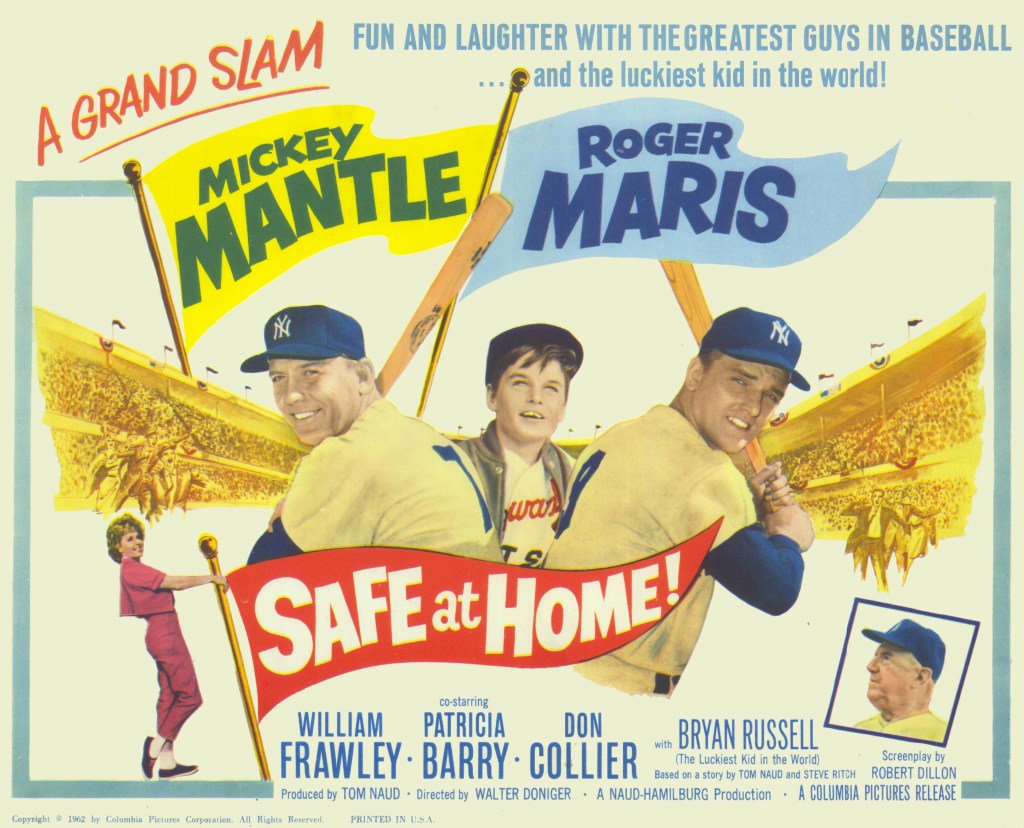
Fittingly, the earliest movie I recall is 1962’s Safe at Home!, a baseball quickie made in the wake of the historic 1961 season in which the New York Yankees’ Roger Maris hit sixty-one home runs to break the single-season record that had been held by Babe Ruth since 1927.
The movie stars Maris and teammates Mickey Mantle (who had also been part of that historic home run chase, ending the season with fifty-four dingers) and Whitey Ford, the Yankees’ best starting pitcher. It was filmed during the New York Yankees’ spring training in Fort Lauderdale, Florida, in early 1962 while Mantle, Maris and Ford were actively participating in spring training. While I’ve never been able to ascertain specific details about the the exact amount of time they dedicated to the film, I have heard that they spent part of two days filming their parts. Some online commentators have noted that the movie feels like a publicity effort from the Yankees, and that’s probably right.
While the film is not hard to find, I’ve never re-watched it. I thought about doing it as part of my research for this piece, but I decided against it on a couple of counts. As it stands, I have fond feelings about the movie and all those who participated in it. If I watched it again I do not imagine I’d feel any better about the movie. There is a chance that I would be depressed by it, that I would see it as the cynical exercise in profit-taking it no doubt was. Besides the movie was not meant to sustain the scrutiny of a 21st century film critic, it was meant as a matinee diversion for little boys.
I don’t remember much about the film but have read plot summaries of it. A young baseball-obsessed boy attends a Yankees spring training game in Florida and comes home to lie to his classmates and Little League teammates about his widower father being friends with the players.
They don’t believe him (they shouldn’t, because he’s lying), so he tries to arrange for the big leaguers to come to a school banquet. Mantle and Maris ultimately refuse to go along with the sham and impart a life lesson about the importance of honesty. I’m sure this lesson was lost on me, I was at an age when I conflated Elvis Presley when my Uncle Roy (both of them had served in the U.S. Army) and believed electricity was a living thing that might, like a snake, bite at you if you came too close.
I thought Mickley Mantle was a family friend.
I imagine I saw Safe at Home! sometime in the summer of 1962 (it was released in June) when I was three years old. The newest research indicates that our earliest memories may begin when we are around thirty months old, which is about a year sooner than was generally thought. So I feel it’s quite possible I remember actually seeing the film rather than remember being told I was taken to see it. I have a sensory memory of black-and-white ballplayers going about their buisness on a big screen, of the faces of the idols looming. I think I remember my first movie.
Still, let’s consider what it means to see one’s first movie, at any age. While some of the stories about crowds panicking when brothers Auguste Marie and Louis Jean Lumiere first projected moving images onto a screen in a basement room beneath the Salon Indien du Grand Cafe in Paris in December 1895 are likely exaggerated, the paying customers were certainly perplexed and maybe unnerved by what they’d seen.
(“Death will no longer be final,” the first movie critic wrote. He was right. We’ve gotten used to watching and listening to ghosts. Maybe half of the music I listen to in a given day was made by people who are no longer alive. )
I imagine that I experienced Safe at Home! the way our subconscious might experience a dream—there was no sense of the unreality of it because I didn’t have the intellectual wherewithal to conceive of anything as unreal. Why would I assume the action wasn’t playing out in real time before my eyes; why would I assume these people were all pretending?
I remember the vague feelings I came away with from my first movie far better than I remember the movie itself.
In Search of Lost Time
I can’t imagine many people have reason to care about Safe at Home! I’ve mentioned it in my newspaper columns a couple of times over the years and I’ve never had anyone send me a note to tell me they remember the film fondly (or at all). I’ve never read a lengthy review of it, so far as I know no Baby Boomer memoirist has ever made any sort of Proustian fuss about the movie the way John Updike and Philip Roth used the John R. Tunis novel The Kid from Tomkinsville in their novels.
(In 1985’s Roger’s Version, Updike used the novel to evoke a sense of nostalgia for a simpler, idealized past, representing a time when heroes like Tomkinsville’s protagonist, star pitcher-turned outfielder Roy Tucker, embodied qualities like perseverance, innocence, and small-town virtue. Roth, maybe partially in reaction, to his friend Updike, has his narrator, Nathan Zuckerman, reflected on the themes of unexpected adversity and the fragility of success explored in Tomkinsville, drawing parallels between Tucker and his own childhood sports idol, Seymour “Swede” Levov.)
The simple reason the film exists is because some people thought it a viable business venture. (It’s difficult to know whether it in fact was, for, at the time, comprehensive box office reporting was less common, especially for films that were not major studio releases or significant box office hits.) Mantle and Maris each got a reported $25,000 for appearing in the film, which seems like big bucks given the era. In 1962, the Yankees were paying Mantle somewhere between $90,000 and $100,000; while Maris might have been making $75,000, so the money was not insignificant.
(It’s interesting to note that Mantle and Maris, along with their teammate Yogi Berra, had filmed a scene at Yankee Stadium alongside Doris Day and Cary Grant in the middle of the historic 1961 season for That Touch of Mink, which was released in June 1962. (Though they filmed the Touch of Mink scene before the Safe at Home! shoot they seem much more relaxed as peripheral celebrities in the company of grown-up Hollywood stars than they do as moral instructors.)

Mantle and Maris were—we now know—complicated men who were shaped by personal struggles and the pressures of their era, but in their time they were presented as uncomplicated avatars of baseball greatness. The general public saw them not as nuanced human beings but as symbols—Mantle as the charming, all-American hero with a prodigious natural talent, and Maris as the quiet, workmanlike athlete whose perseverance broke a nearly sacred record. This sanitized presentation wasn’t unique to them; it reflected a broader cultural tendency to simplify public figures into archetypes, especially for the consumption of children.
For children, this dissociation between a person’s humanity and their role is particularly pronounced. A child’s worldview is naturally compartmentalized, built on straightforward categories that make it easier to navigate a confusing world. Teachers, for instance, are often imagined to live at school because that is the only context in which children see them. Similarly, TV actors seem to exist only inside the TV, and baseball players seem to inhabit the ballpark, their personal lives invisible and irrelevant to the child’s understanding of their role.
This compartmentalization is reinforced by the way icons like Mantle and Maris were portrayed in media. In Safe at Home! and countless other cultural products of the time, athletes were depicted as idealized figures—larger-than-life embodiments of honesty, determination, and athletic excellence. The film’s message about integrity (even as it featured players whose own lives were far more complicated) wasn’t just a moral lesson; it was a reinforcement of their roles as heroes, not humans. To a child watching Safe at Home!, Mantle and Maris weren’t individuals with personal struggles, family dynamics, or inner contradictions—they were baseball.
As we grow older, of course, we begin to reconcile the person with the role. We learn that Mantle battled injuries and addiction, that Maris struggled under the weight of public scrutiny and fame. But in childhood, that distinction doesn’t exist. The ballpark was their home, just as the classroom was the teacher’s, or the TV set the actor’s. This separation of identity and role, while naive, allows a child to fully invest in the fantasy of their heroes, unburdened by the complexities of real life. It’s a kind of innocence that we only fully understand once it’s gone.
It’s tempting to imagine a novel in the Updikian-Roth tradition—a richly layered, fictionalized account of the relationship between Mantle and Maris during the 1962 season. Their partnership, forged in the crucible of the 1961 home run race, seems ripe for literary exploration. Were they trying to be more than ballplayers, or was the simplicity of that role both a refuge and a prison? Such a novel might include a chapter on the filming of Safe at Home!, capturing the strange dissonance of two men stepping outside their well-worn identities as athletes to play at being moral guides in a movie that treated them as symbols rather than people.
One can imagine the tension: Maris, ever the reticent and reserved one, perhaps wondering if this latest detour—like the endless press conferences and commercial appearances—was another small betrayal of his quieter aspirations. Mantle, more gregarious but no less burdened, might have viewed the experience with a mix of resignation and amusement, aware that he was playing a role on and off the screen. Both men, standing under the klieg lights of a makeshift spring training set, might have questioned what it meant to step outside the ballpark and into the realm of Hollywood. Did they see it as a chance to transcend the confines of their sport, or did they feel like reluctant participants in the ever-expanding spectacle of celebrity culture?
In this imagined narrative, the making of Safe at Home! would serve as a microcosm of the broader dilemmas they faced: the tension between their public personas and private selves, the strain of living as avatars of a game that demanded not just physical greatness but a kind of moral simplicity. And yet, like all artifice, the film’s staged lessons about integrity would stand in stark contrast to the messiness of real life—their lives. Perhaps that’s the real drama: not what the film sought to teach, but what its stars revealed, knowingly or not, about the uneasy intersection of myth and reality.
That’s the nature of art: It exists independently of those who collaborate to make it. Safe at Home! doesn’t matter much to the culture at large, to any overarching story we want to tell about our society or times. Yet there are probably thousands of kids like me who saw it at an impressionable time and on whom it had a significant impact. Everyone has a first movie, an arrangement of light and sound that ambushes us — a first time that can never come again.
Cinematic Literacy
Thinking about Reflecting on Safe at Home!, I’m struck by how much the experience of seeing it—as opposed to the film itself—shaped my sense of what movies could be. It was, in hindsight, an unremarkable film. Yet, for a child who saw the world as wondrous and immediate, it felt monumental. I suspect that’s the magic of early cinematic experiences: they teach us how to feel before we learn how to analyze.
We learned things from movies. Maybe not moral lessons, but how to smoke a cigarette and how to lean against a car. How to dress, how to court affection, how to be stoic—strong and silent—and how to imagine ourselves the hero of our own narratives. We were to a degree warped by movies, they had a certain gravitational pull, a certain profound allure. For better or worse there was something special about the movies.
I’m not sure that holds today. Cinematic literacy—the ability to read and appreciate films as art, storytelling, and cultural reflection—has diminished over the years. The rise of streaming platforms, algorithm-driven content, and fragmented attention spans has transformed how we watch, and perhaps more importantly, how we remember. While my generation stumbled wide-eyed into movie theaters, confronted by looming faces and larger-than-life stories, today’s first cinematic experiences are often mediated through smaller screens, broken into digestible fragments, or blended into the digital noise of other distractions. The kids are platform neutral—for a movie, any screen will do.
Maybe Norma Desmond was right — the pictures have gotten small.
Losing the Thread
A few years ago I read an essay Steven Whitty that appeared online at njarts.com a couple of weeks ago that bore the unwieldy but search engine-optimized headline “As opportunities to see old movies fade, so does basic cinematic literacy.”
Whitty was the chief film critic at the Newark Star Ledger for more than twenty years and is a contemporary of mine. He began professionally writing about film in 1987 (I wrote my first film review in 1986) and reports that his first movie was Disney’s Pinocchio, which he remembers seeing when he was three years old. (Pinocchio was first released in 1940 but it was re-released in 1962, which is probably when Whitty saw it.) He’s one of the critics I regularly read, and I’m grateful that social media platforms for making that possible.
In this particular essay, Whitty laments a recent poll he’d seen for “the fifty best romantic comedies in movie history.” It was conducted “by a popular website” that Whitty didn’t want to call any further attention to because of the fifty films listed in the poll, “forty-nine of them had been released since 1980.” The other film listed was 1971’s “Harold and Maude.”
“Apparently, their idea of ‘movie history’ doesn’t stretch back quite as far as mine,” Whitty writes. “[Commenters asked] where was The Apartment? It Happened One Night? His Girl Friday? Annie Hall? One of the list’s compilers responded with an online smirk, sarcastically thanking people for being upset. After all, that merely meant more clicks and ad revenue for the site so, you know, the joke was on us.”
(How beauteous mankind is! O brave new world, that has such people in’t! … )
In the piece, Whitty writes about how the collective ability to “read” a film, to engage with its language of images, gestures, and subtext, has eroded. It’s not just that we’re watching on smaller screens, but that the act of watching itself has become smaller, reduced to snippets consumed between other distractions. We’ve moved from immersive, communal experiences to fragmented, solitary ones, and in the process, the movies have lost some of their magic as cultural wayfinders.
Once, movies were more than entertainment; they were instructional, aspirational, even mythological. They shaped our identities in ways we weren’t always conscious of. Whitty suggests that the decline of cinematic literacy parallels the diminishing influence of film as a cultural cornerstone. The shared language of cinema—how to interpret a long, meaningful glance, how to decipher a scene’s blocking, or how to understand a cut as more than a convenience—has been diluted. Instead, algorithms feed us what we already like, delivering a passive, surface-level engagement. The artistry of the medium, its ability to inspire a kind of active, participatory watching, now struggles to reach an audience trained to consume rather than contemplate.
In the age of platform-neutral kids and ubiquitous content, what are we losing? Not just the bigness of the screen but the bigness of the experience—the lingering resonance of a film that stays with you long after you leave the theater, and the shared cultural fluency that came from a world where most of us watched the same stories unfold in the same darkened rooms. Whitty’s essay raises an urgent question: If cinematic literacy is fading, can cinema as art survive?
Whitty goes on to challenge the very idea of “old movies,” quoting the late director, film scholar and occasional actor Peter Bogdanovich.
“There are no old movies,” Bogdanovich would say. “There are only movies you haven’t seen before.”
I understand Whitty’s frustration. Even would-be movie critics have sometimes startled me with their dismissive attitude toward what they invariably call “old movies.” In 2019, a would-be contributor to our movie section pitched a piece on the new Netflix film The Highwaymen about the Texas Rangers who tracked and eventually killed notorious outlaws Bonnie and Clyde.
When I asked him how the film compared to—and whether it in any way paid homage to—Arthur Penn’s 1967 classic movie, this very bright young writer blithely replied that they hadn’t seen Bonnie and Clyde but that he’d heard from friends “it wasn’t any good.”
Now it is fine not to like Bonnie and Clyde, but we ought to understand there are any number of films where we might say cinema splits off into new directions—where the once unimaginable is imagined and becomes part of the grammar of film going forward. John Ford’s Stagecoach (1939) is one of these. Alain Resnais’s Hiroshima, Mon Amour and Robert Bresson’s Pickpocket, both released in 1959, were others.
And Bonnie and Clyde is where realistic hard violence married to gleeful comedy enters the American cinematic lexicon, specifically in an early scene where Beatty as Barrow shoots a middle-aged bank manager in the face after he’s jumped on the running board of their getaway car.
This one of the earliest instances where American movie audiences are faced with the graphic consequences of violence. The camera doesn’t cut away from the victim, we see blood and what appear to be bits of brain and bone flecking the car window.
You can draw a straight line from Bonnie and Clyde to the work of Quentin Tarantino. If you mean to write about the movies in any serious way, you need to know this stuff.
If you’re going to be a responsible and alert consumer of culture, you need to understand how movies work and are different from books and music and photography and painting (though they in some ways encompass and recombine all these arts and disciplines).
Cinematic literacy might sound like an arcane pursuit, but it’s really only responsible consumption. You want to know what you’re putting in your body; you want to know what you’re putting in your head.
One of the great things about our digitized and time-shifting era is that we all have — or can easily obtain — access to a massive library of movies that are new to us. I’ve written before about our COVID-19-inspired project of watching (or rewatching) movies from past decades like The Friends of Eddie Coyle from 1973, or The Hit, a 1984 film by Stephen Frears that’s often overlooked.
This isn’t like a compulsory Continuing Legal Education seminar; we’re doing this because it’s enjoyable, because part of what people want from the movies is transport, a removal from the quotidian.
The impulse isn’t entirely nostalgic—I’d prefer to see a new old movie, something I’d missed or forgotten about, rather than revisit a movie that’s familiar.
All of us have blind spots, and no one can possibly keep up with every movie (or album or book) ever released, but if your job is to write and think about movies, then it’s only responsible to try to keep up. No one has to care about anything in particular, but I’m with Whitty: If you mean to put out a list of the best romantic comedies in movie history, you ought to have an intimidating inkling of the vastness of that movie history.
Whitty notices that this kind of ageism “seems to disproportionately apply to cinema.”
“In other disciplines,” he writes, “works that have come before — whether it’s Beethoven’s Ninth Symphony, Dickens’s Great Expectations, Miles Davis’s Kind of Blue or Andrew Wyeth’s‘Christina’s World’—are seen as classics, as part of a continuum. They’re not simply written off as old, and true aficionados appreciate them on their own terms.”
Anything that happened before we were born is as remote to us as ancient Rome. It’s not part of our reality.
Whitty has noticed this, and thinks it applies especially to the movies.
“I‘ve taught film students—many of whom want to make their own movies — who seem to think cinema started with Pulp Fiction,” he writes. He’s right. I’ve talked to wannabe film writers who have no interest in anything that came out before 1999’s The Blair Witch Project. (Which is, to be fair, a product of the last century.)
Whitty has the idea that the problem isn’t the result of a “lack of access to media, but from too much.”
When Whitty was growing up in the ’60s and ’70s, he writes, his “TV options consisted of Channels 2, 4, 5, 7, 9, 11 and 13.” Seven choices — which was a lot, about the same my family had when I was a child in Southern California, quite a bit more than I had a high school student in Louisiana.
“But the thing was,” Whitty writes, “every one of them programmed movies, every day. Because there was no cable then—never mind videos or DVDs—most of these were older movies, from decades past. And they were simply part of the programming, seamlessly integrated with the new. You grew up just accepting them.”
Whitty argues that while we have hundreds of options available today, classic films are relatively hard to find, at least compared to new horror films and comedies.
I take his point with some modification— when Whitty argues that it’s difficult to find old movies,m I think what he’s really saying is that it’s difficult to serendipitiously encounter old movies. If you are purposefully seeking then, there’s TCM and, for the snobs, The Criterion Channel (I’m a charter subscriber). But most people are probably not as mindful of their viewing as those of us who write about movies and television programs; some turn on the box and start scrolling.
We saw what was put before us. We cleaned our plates and liked it.
Now the classic movies that are out there are lost in a sea of reality programming and algorithm-generated new suggestions. We’re not forced to watch older films because they are our only option—our options are seemingly endless. We can live in our own silos, never having to encounter anything we haven’t consciously considered.
It’s like the hollowness I feel when browsing Apple Music or Spotify. Virtually all music is available, but this completeness comes at the loss of the serendipitious thrill of flipping through racks of a record store. If we know what we want we can get it. But we have fewer ways of discovering what we want by accident.
What we lose is a cohesiveness of our culture. There are fewer points of common reference, fewer shared ideas in the common reservoir.
Our Movies, Our Mythology
“In other countries, many children still grow up on ancient folktales — Norse sagas, Greek myths, Arthurian romances,” Whitty argues. “But we’re a relatively young nation. We don’t have a wealth of stirring stories passed down from generation to generation. The few we used to have — the adventures of Paul Bunyan, say, or the tale of Johnny Appleseed — faded away long ago.
“No, in America, the movies are our mythology, or used to be. They were a common cultural touchstone, and a way of explaining the land we lived in, and the people we met here. They provided cautionary tales, moral lessons, national symbols, cultural archetypes. They still can.”
I’m not sure that the rest of the world isn’t more like America than Whitty is willing to concede here, but again his argument is sound. We don’t just learn history from history books — for more than a hundred years now, movies have instructed us on how to talk, flirt and carry ourselves.
Safe at Home! as my first movie, I realize it wasn’t just about baseball or childhood heroes. It was my introduction to the magical language of cinema—the way a screen could amplify a moment, a gesture, or a lesson, however simplistic. As Steven Whitty suggests, movies used to be our mythology, shared stories that taught us how to live, dream, and even lie convincingly to our classmates. Safe at Home! was no Citizen Kane, but for a three-year-old, it might as well have been. It showed me how movies could blend fantasy and reality, shaping how I saw not only Mantle and Maris but also myself in the mirror of their larger-than-life personas.
The movie’s simplicity—its black-and-white moralizing, its naïve hero worship—might feel dated in an era that prioritizes irony and spectacle. And yet, that simplicity also embodies what we risk losing as cinematic literacy fades: the ability to see movies not just as content but as cultural wayfinders, luminous ghosts who remind us of where we’ve been and where we still might go.
We can recognize ourselves in these ghosts, we can identify with and relate to them.
But we have to meet them first.
 Where Kael Now Need?