Here’s my digitized sketch of our dog Savannah.
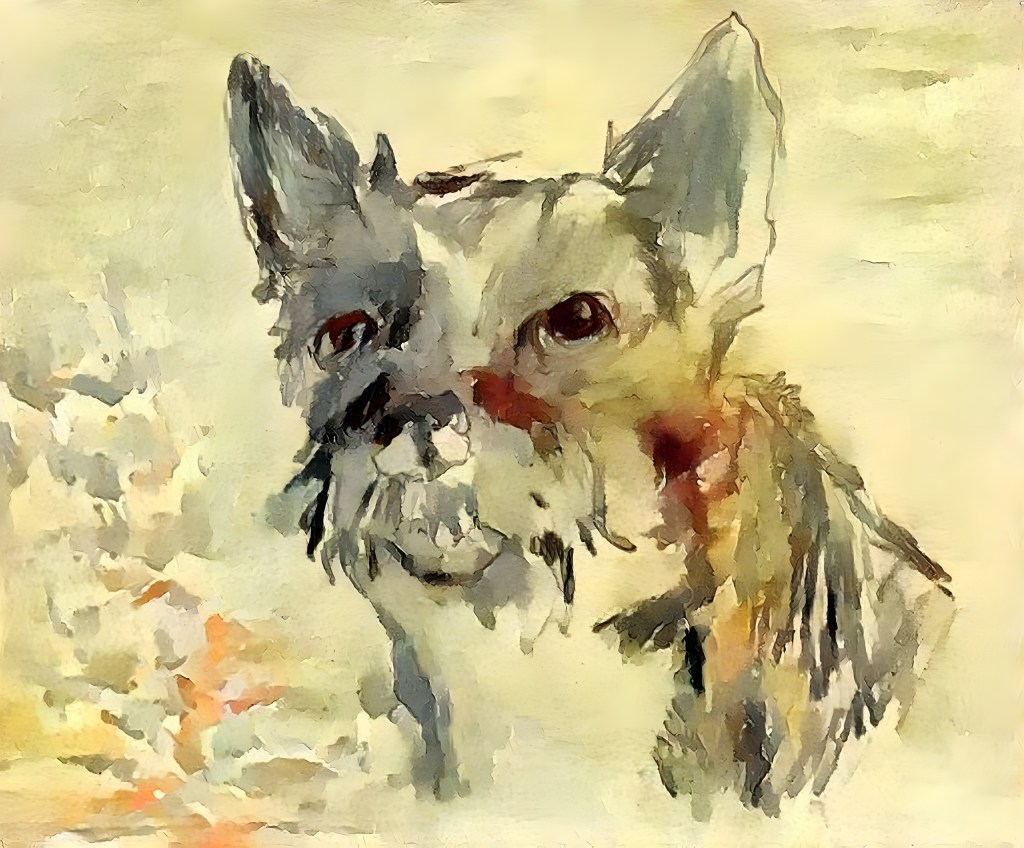

Here she is with her sister, Rikki Tikki Tavi.
Here’s my digitized sketch of our dog Savannah.
Here she is with her sister, Rikki Tikki Tavi.
I don’t run around with no mob
Got myself a little job
I’m going to buy me a little car
Drive my girl in the park
Don’t bother us, leave us alone
Anyway we almost grown
— Chuck Berry, “Almost Grown,” 1959
If we are lucky, we experience a period in our lives when we only believe we are adults.
This time may come in college or in its afterglow, and while we’re in it it might seem terrible. We might have little or no money. We might be anxious about our prospects for ever finding a proper place in society. We might fear never finding someone who could love us while knowing us at our most frightened and shame-ridden.
We might have a low-stakes job, a shabby apartment, a few nice things, but maybe we still do our laundry at our folks’ house. If we live in another town or city or state or another country halfway around the world, we still know we can call them if things slide sideways. Even if you never avail yourself of this option, knowing that you could at least ask for help is a species of privilege. Having somewhere to run is a luxury, not a birthright.
For most of human history, young men have served as cannon fodder. We were expendable, a herd that needed to be thinned for economies to keep humming along. Sometimes I think war was invented for young men to have something to do. War also eases the pressure on old men looking for second and third wives.
I was born too late for Vietnam, coming of age after the draft ended. I didn’t have to choose between Canada and southeast Asia. I was part of a lucky generation. I just didn’t know it.
In 1984, almost all my friends were post-collegiate unsettled and poor. We were almost grown. We lived in rent houses. We never imagined how we might escape into the middle-class lives our parents expected us to adopt.
Maybe it was better then than it is for similarly situated young people today. Jobs were not hard to come by. They generally paid a living wage. I was a cop reporter who reviewed records and concerts on the side; I had a couple of regular freelance gigs. I went to work at 3:30 a.m, Sunday through Thursday, prowling a city that averaged more than a murder a day.
My schedule allowed me vampire hours. I slept in the afternoon. I was usually up and out after dark. I went to clubs along Shreveport’s Kings Highway, like the Blarney Stone, the Rusty Nail, and the Killer Poodle. I also visited clubs in Shreve Square, mostly Humphrees, though there was a cavernous club called the Cotton Exchange for a while. Availability is an ability, the sports writers say, so maybe that was why Eddie approached me about starting a band.
My credentials were not great. I had won a national songwriting contest while in college. This gave me the opportunity to perform on “The Merv Griffin Show” and to play a couple of songs in a Nashville steak house before the headliner, a up-and-comer who had just released his first album named Lee Greenwood, took the stage. I also played solo in fern bars where nobody really listened. I had been onstage a few times with Eddie on bass. My old songwriting partner had recently decamped to Florida to play piano in a resort bar. I had a shaky tenor that was close enough for rock ’n’ roll and knew all four guitar chords. I still don’t know why Eddie considered me the essential front man.
But anyway, it was Eddie’s band. He recruited the others. I didn’t know them from before. Jimmy and Linda were a married couple. He played guitar and she played keyboards. She had a pure crystalline timbre to her voice, which she insisted be limited to backing vocals. Tony was a slightly older Black guy. I’m changing his name because of what happened to him afterward. He was our drummer, though he could play anything. He also sang lead in a soul group, his other band. I came to our first practice in Eddie’s meager living room. I brought a spiral notebook full of songs, a deep-bowled Ovation, and a Tokai Stratocaster knock-off.
I didn’t have an amp. I’m not sure I had a cable.
■ ■ ■
It was not terrible, though I was scared to death.
I played a few of my songs. Eddie already knew most of them. The rest of the band fell in behind me with a startling propulsive power. Jimmy was very good. He was one of those instinctive musicians who could dig down into the guts of a song. He would pull out all manner of springs and sprockets, discard what was unnecessary, and shine up the rest. Then, he would slip them back in place. He was like a mechanic rebuilding an engine as the car rolled down the road at 80 mph.
Whenever we’d slide to a stop during practice he’d spontaneously break into a snippet of “Crazy Train.” Sometimes, he’d play Eddie Van Halen’s “Eruption.” Other times, he’d choose Van Halen’s version of “You Really Got Me.” Occasionally, he performed Isaac Albéniz’s “Asturias (Leyenda)” movement from “Suite española, Op.47.”
I’ve since met a lot of players who can do this. He was the first guitarist I ever knew who could listen to a piece of music once. He could then immediately play it back in its entirety.
Tony was our other virtuoso — the best musician in the band. One of our set pieces had Eddie and me walking offstage while Jimmy and Tony thrashed on. Then Tony would throw down his drumsticks, pick up my Tokai and trade guitar solos with Jimmy. Eddie would climb behind the drums and Linda would lay down the bass line on her Fender Rhodes. I’d come back and we’d swing into either the Rolling Stones’ “Miss You” or T. Rex’s “Get It On (Bang a Gong).”
I would always get lost on “Get It On.” I still can’t figure out the song’s phrasing. We worked that confusion into the act. I smile when I’m nervous. I laugh when I’m afraid. We could put the song over most of the time. I don’t ever remember it completely collapsing. That might be my memory being merciful.
My songs made up the bulk of our material — probably 80%. They were wordy and odd, not quite love songs, and most of them make me wince today. But I still play a couple of them.
Eddie arranged a hardcore punk version of Hank Williams’ “Your Cheatin’ Heart.” It always got the biggest reception when we played live. He had a couple of other country songs he similarly abused. Sometimes I played and sang Bruce Springsteen’s “Thunder Road” on my acoustic by myself. Other times, Linda joined me. She dropped piano chords over my tentative vocal. Her soaring harmonies lifted it up.
Not too long ago I found a tape of myself performing “Thunder Road” live in a club. It sounded strange to me. My voice has darkened and deepened. In many ways, I think I’m a better singer now. But there is a certain quality to that recording, a vulnerability that, at the time, I probably loathed. But it was nothing to be ashamed of. Sometimes, when I think about those days, I think we could have been very good.
■ ■ ■
We had a little success.
Tom Ayres — who brought David Bowie to RCA Records — became our manager. Ayres had let the young Bowie stay with him in his Hollywood Hills home. At that time, Bowie was still known as David Jones. The home was a mansion formerly owned by silent-movie actress sisters Lillian and Dorothy Gish. Tom was one of those essential behind-the-scenes record company guys; in his career he worked for Hanna-Barbera Productions, ABC Records, Columbia Records, United Artists, Kama Sutra Records, and Buddha Records, as well as RCA.
Originally from rural Sabine Parish, Louisiana, Ayres settled in California after a stint in the Army Air Corps. He played bass in Johnny Burnette’s Quintet and produced acts like Jay and the Americans. He worked with the Sir Douglas Quintet. He’d managed Gene Vincent.
Then he convinced Bowie to sign with RCA. The “Major Tom” in Bowie’s “Space Oddity” may be a reference to him. Ayre’s in the Rockabilly Hall of Fame. He was very close to legendary Los Angeles DJ Rodney Bingenheimer; he told us he could get anything played on Bingenheimer’s show on KROQ.
I met Tom after he’d moved back to his home state; he was working with Dale Hawkins, the cousin of Ronnie Hawkins, the guy who wrote and sang “Suzie-Q.”
He’d heard about me winning my contest, and I played him some songs. He arranged for me to recording five of them, solo acoustic, as demos. The recording engineer didn’t think my voice was strong enough to carry the songs. I agreed with him. Tom didn’t think they were the sort of thing a Nashville combine would be interested in. I agree with that too. So we tabled the project.
But after Eddie put the band together, I invited Tom to a rehearsal.
I don’t think we ever signed anything. He booked us some studio time. He also arranged for us to shoot a video.
■ ■ ■
The recording went well; we knocked out a couple of songs in a couple of hours. I was nervous singing, so Linda stood behind the glass in the control room and sang with me. I could watch her and know when to come in. Tom brought in Danny Johnson. Danny was a local guitar hero who was then in Rod Stewart’s band. He overdubbed a second guitar solo over what we considered the “A” side. He used my Tokai, and nailed it in two takes.
Then he asked if he could buy the guitar from me. I think he gave me two hundred dollar bills and took it home that night. I miss that guitar.
We didn’t press any vinyl but we sent out tapes. Here and there radio stations played one or both of the songs. Somewhere I still have a cassette recording of an air-check of Bingenheimer introducing our songs on his show.
Our video shoot did not go as well. We rented a theater in downtown Shreveport. We invited everyone we knew to watch us. We lip-synced our two songs again and again.
Before the shoot, Tom had set us up for hair and makeup. The stylist who got ahold of me teased my hair straight up a la Billy Idol. I grinned at her and told her I liked it but as soon as I got to my car I mussed it up and pressed it down, trying to mold it back into something that looked, or at least felt, more like me.
I almost got it into acceptable shape when we walked out on stage. It was poofy but I didn’t look like a New York Doll. I walked to the mic stand and looked down at the crowd. There, front and center, two feet from the lip of the stage, stood my stylist. Her arms were folded. Her eyes were drilling holes in my skull. She didn’t move all night as we did take after take and our friends and family jumped around acting like we pretenders were blowing them away with our maximum rock ‘n’ roll.
■ ■ ■
I think the video ended it for me.
I was embarrassed by it — I looked like (because I was) a poseur.
We were not glam rockers. We were not anything really. My songs were both earnest and snide. They were relatively free of swagger. I wanted a more acoustic, organic sound — Jimmy and Linda wanted to rock harder in a mainstream vein. Eddie had his retro tendencies; Tony brought the funk. It could have worked, but I was the weakest link and couldn’t hold it together.
It was fun, but it was also scary being up on stage. I never got over the feeling that the band behind was bearing down on me like a tailgating tractor trailer.
And it wasn’t getting better for me. While the band became more fluid and locked together. I felt more and more exposed and vulnerable. I didn’t think I could keep up.
So we played an outdoor showcase at the Red River Revel, got paid a little, and I walked away. Maybe nine months after Eddie had convened us in his living room, it was over. My work just won’t allow this any more, I told them. Best of luck.
They took it in stride. They wandered off to other bands. Jimmy and Linda got divorced. He went to California.
Tony got murdered. Stabbed to death near the railroad tracks. I don’t think the case was ever solved.
Eddie persisted. Eddie prevailed. We still talk sometimes.
He’s got a new band now. They still do some of the songs I wrote in the ’80s.
■ ■ ■
Forty years later, I think about all this and I realize we weren’t so special.
We were almost grown. We were like thousands of others who coalesced around rock ‘n’ roll music, in a way I don’t imagine is still possible. It seems like half my friends were in bands in the ’80s. Everybody had rehearsal spaces. We all went out to clubs and watched each other’s bands. We loaned each other records and sometimes we didn’t get them back.
The best part of those rehearsals was the part at the end where we’d stop and play records. The Replacements’ “Let It Be” was a big practice room favorite — I remember we were going to work up a cover of “Answering Machine” but some other local band — synth-based, for goodness sakes — beat us to it. I would bring in “Exile on Main Street.” Eddie introduced us (on record first, later literally) to Jason and the Scorchers. Tony brought in Marvin Gaye (who was one of the background singers on Chuck Berry’s “Almost Grown”).
For me, that life was like cocaine. I liked it so much it scared me. I think I had to get out, that it was the only way to save my own life.
In his essay “In Which Yet Another Pompous Blowhard Purports to Possess the True Meaning of Punk Rock,” Lester Bangs got to the gist of it.
“The point is that rock & roll, as I see it, is the ultimate populist art form, democracy in action, because it’s true: anybody can do it,” Bangs wrote. “Learn three chords on a guitar and you’ve got it. Don’t worry whether you can ‘sing’ or not. Can Neil Young ‘sing’? Lou Reed, Bob Dylan? A lot of people can’t stand to listen to Van Morrison, one of the finest poets and singers in the history of popular music, because of the sound of his voice. But this is simply a matter of exposure.
“For performing rock & roll, or punk rock, or call it any damn thing you please, there’s only one thing you need: NERVE. Rock & roll is an attitude, and if you’ve got the attitude you can do it, no matter what anybody says. Believing that is one of the things punk rock is about. Rock is for everybody, it should be so implicitly anti-elitist that the question of whether somebody’s qualified to perform it should never even arise.”
So, yeah, I did it. I was in a band. And I quit the band for the same reason most people quit most things. Because I was afraid. Because I lacked the single quality Brother Bangs said was necessary.
It is a wonder we can ever forgive our younger selves for the crimes they committed against us.
You don’t start out wanting to be a sportswriter. At least, I didn’t. I wanted to be in the game, not on the sidelines taking notes.
I wanted to be a ballplayer. Not just because it’s where everyone’s attention is focused. It’s not only where the contests are decided. It seemed a cleaner, simpler way to live. I was a boy who liked running, throwing, and seeing things settle with a clear verdict. Like Alexander Portnoy, I “longed to be a center fielder, a center fielder and nothing more.”
Actually, I wanted to be a shortstop.
And I saw no reason I couldn’t be that, other than the obvious fact that some boys were stronger and faster than I was. But Coach Clair Bee’s books promised that if I ran the extra lap, focused harder, or simply wanted it more I could overtake my betters.
So I trained. I carried bricks in either hand as I ran up and down stadium steps. I read The Art of Hitting by Ted Williams, believing that if I absorbed it, greatness would follow. I sharpened my reflexes by hitting tennis balls I’d thrown against a concrete wall. Among all the boys I knew, I was the best at catching a spinning bottle cap with a swung broomstick.
I told myself the lie we all secretly believe: that I was different, that within me lay a kernel of greatness that would inevitably bloom.
But as Harry Callahan famously advises, a man’s got to know his limitations. I found mine early enough to start negotiating compromises. Life became a process of offering trades to the universe: Maybe I couldn’t be the quarterback, but I could still chase after or block for him. Maybe I wasn’t the one to stand front and center in the band, but I could keep the beat or, if nothing else, load the equipment on the bus.
And so, finding myself less exceptional than I’d hoped, I did what many of us do. I went to school and obtained credentials. I acquired skills that would allow me to be useful in a world indifferent to my ambitions.
We come to know ourselves as our possibilities foreclose. As we are thwarted, we are shaped.
I didn’t want to be a sportswriter, but I became one.
I left law school intending to take just one year off. To make ends meet, I took a job as the sports editor of a small newspaper in Jennings, Louisiana. I wasn’t exactly qualified. The Jennings Daily News published only six days a week. It had no Sunday edition. This schedule made it a manageable trial by fire.
After a year, an opportunity opened at The Shreveport Journal, a scrappy afternoon paper in the city. They hired me partly because they needed someone who could play on their slow-pitch softball team; the editor took the team far too seriously; most of the players had played beyond the high school level. I filled the gap on the left side of the infield and, suddenly, was also filling the role of a cop reporter, covering stories of murder, loss, and all the sadness of life on the front lines.
Then, at 25, I became a columnist. Three days a week, my columns ran from the bottom of the front page of the newspaper, with the continuation—the jump —inside. I still felt like a failed athlete and an inchoate person, a young man biding his time until he could return to law school and pick up where he’d left off. But writing those columns started to change something in me.
One day, my city editor, Tom Mitchell, called me over. He was a gruff man with a biker mustache and an Elvisian mop of hair. (“A swatch of hot buttered yak wool” was how Time described Evis’s pompadour in 1966; that was probably what Mitch was going for.) Looking me square in the eye, he asked, “Are you a writer, or are you a reporter?”
Until that moment, I hadn’t seen the act of writing as a way of getting off the sidelines and into the action. I told Mitch I’d be a faithful reporter, and I meant it. But as I began to write my columns, I started to see that a critic isn’t just a spectator. There’s a rhythm, a strategy, a chance to shape and influence the story unfolding in front of us. Writing was its own way of being in the game.
Before Mitchell’s question I’d never considered myself to be anything more than a dumbass kid waiting for life to start. Even if he was joking the question seemed to suggest I was more than that, and I was taken aback. I was smart enough to know what he wanted me to say, though, so I told him I would never abuse the freedom and trust the paper had given me by imagining that my style was more important than the story. I told him I was—and always would be—a faithful reporter.
But the question lingered, echoing in my mind. For the first time, I began to see myself differently, to wonder if maybe I was something else, or at least becoming something else.
Looking back now, it seems obvious. I’d been writing for years—record reviews, regional publications, even under a pseudonym, “Jim Gatz” (the real name of Jay Gatsby). As a teenager, I wrote songs, won poetry contests, and filled my head with the words of authors I loved. Yet until that moment, I never thought I shared anything with the writers I admired. Writing had been an escape, a skill, even a secret—never something to claim as my identity.
Tom was probably teasing, but his question broke open something inside me. In a single moment, I’d gone from someone waiting for life to begin to someone actively making sense of it.
•••
Pauline Kael was one of those writers I devoured.
When I first started reading her, I was still convinced of my own specialness. I thought writing was something that everyone did from necessity but I gave no thought to the possibility of it as a profession.
I also thought very little about the movies.
They were just movies, something to do on a Saturday night. (Or, more often, a Tuesday night when we could go for a dollar.) I liked them, because who doesn’t like movies? But I gave no more thought to how they came into existence, to who made them or why, than I considered the manufacturing processes of vanilla ice cream or Coca-Cola.
The exact reasons I sought out Pauline Kael’s review of Last Tango in Paris in The New Yorker at the Airline High School library are hazy to me now. Maybe it was because of the whispers I’d heard about Marlon Brando and a stick of butter, or perhaps it was Maria Schneider’s raw, unfiltered presence on screen—she seemed different, more vulnerable and honest than other actors I’d seen. Either way, I was unprepared for the explosion of language I encountered in Kael’s review: a wild, technicolor plume of words, filled with excitement and revelation. Her prose struck me like a revelation, something that left me breathless. In that moment, I felt something I hadn’t felt with movies before—a curiosity to understand not just the plot, but the deeper pulse of the story, the emotions and ideas that made the film feel alive. Kael wasn’t just recounting the story; she was using the film as a launchpad for something bigger, a way of examining the world itself:
The movie breakthrough has finally come. Exploitation films have been supplying mechanized sex — sex as physical stimulant but without any passion or emotional violence. The sex in Last Tango in Paris expresses the characters’ drives. Marlon Brando, as Paul, is working out his aggression on Jeanne (Maria Schneider), and the physical menace of sexuality that is emotionally charged is such a departure from everything we’ve come to expect at the movies that there was something almost like fear in the atmosphere of the party in the lobby that followed the screening. Carried along by the sustained excitement of the movie, the audience had given Bertolucci an ovation, but afterward, as individuals, they were quiet. This must be the most powerfully erotic movie ever made, and it may turn out to be the most liberating movie ever made. … Bertolucci and Brando have altered the face of an art form. Who was prepared for that?
Certainly not me, the fourteen-year-old infielder.
Don’t misunderstand. I wasn’t a feral kid. My parents evinced a touching suburban veneration of books that verged on fetishism. Our house had bookcases tight with yards of Reader’s Digest condensed hardbacks, book club editions of popular novels, a rich trove of paperbacks and a few volumes that reflected some fairly esoteric interests in Greek mythology and poetry.
My father was a fan of Philip Larkin and Alfred Lord Tennyson. He also had a copy of E.E. Cummings’ Collected Poems 1922-1938, though I got the feeling he didn’t much care for any of them aside from “i sing of Olaf glad and big,” which he could recite from memory.
We had two sets of encyclopedias — Grolier’s Encyclopedia Americana and their New Book of Knowledge (which I imagined I had outgrown by the time I went looking for intelligence on Last Tango) and a ten-volume set of Grolier’s Classics bound in red leatherette, which I was studiously working my way through. I read abridged versions of Lamb’s Essays for Elia and La Rochefoucauld’s Maxims and Reflections before I ever read Pauline Kael.
My parents did not subscribe to The New Yorker, but they took many magazines — among them National Geographic, Time and Newsweek, Redbook and, for a time, McCall’s (briefly Kael’s employer, though I never noticed). I had my own subscriptions to The Sporting News and Sports Illustrated.
I was a reader, often absorbed by text. They tell me as a child I would sit for hours cross-legged on the floor with a book in my lap, my elbows on my knees and my hands cupped over my ears. My mother says I would tune out the world, to the point where my attention could only be gain by placing a hand on my shoulder. She says she might have worried about me had I not had other interests, and that today such behavior might be mistaken for high-functioning autism.
All I know is that I could dive deeply into books that were above my grade level. I remember reading Nancy Freedman’s sci-fi political thriller Joshua, Son of None, about a boy, Joshua Francis Kellog, cloned from a dying American president (who also had the initials “J.F.K.”) in a single sitting.
I remember the next book I attacked, with similar enthusiasm, was Erica Jong’s Fear of Flying. (I was going to write about the novel on the occasion of the fiftieth anniversary of it’s publication in 2024 but in my research I came across an essay on the book by Emma Brockes, a New York-based columnist for The Guardian, which boiled down everything I wanted to say into one perfect sentence: “It was the first time I’d read about adult relations and not been bored witless.” I don’t think I can say it any better than that.)
In high school I was very much aware of Kurt Vonnegut, whose Breakfast of Champions was loaned to me by one of my friend’s mothers, and John Cheever and John Updike. I read Falconer and Rabbit, Run. I was self-consciously aware of the people who wrote books; I was even more aware of sportswriters like Joe Falls, Furman Bisher, Jerome Holtzman, Dick Young and Jim Murray who I read every week in The Sporting News. I noticed writers.
But Kael was different from the other writers I noticed — there was a sense of urgent performance driving her words. She wasn’t just talking about the show in the manner of the genial (and sometimes not) sportswriters I liked reading; there was a sense that, at least in some sense, her work was the show. Or at least a show.
Kael wasn’t simply describing what was happening in the movie — reading the review, I didn’t even get much of a sense of what happening in the movie — she was using the occasion of the movie to talk about things unrelated to whether Last Tango in Paris was an amusing diversion or not. She seemed to be communicating something important about the way we could live in the world. And though I didn’t completely understand what she was saying, I was intoxicated by the rhythm and rack of her words, mesmerized by the sparks they made as they knocked one against the other:
His first sex act has a boldness that had the audience gasping, and the gasp was caused — in part — by our awareness that this was Marlon Brando doing it, not an unknown actor. In the flat, he wears the white T-shirt of Stanley Kowalski, and he still has the big shoulders and thick-muscled arms. Photographed looking down, he is still tender and poetic; photographed looking up, he is ravaged, like the man in the Francis Bacon painting under the film’s opening titles. We are watching Brando throughout this movie, with all the feedback that that implies, and his willingness to run the full course with a study of the aggression in masculine sexuality and how the physical strength of men lends credence to the insanity that grows out of it gives the film a larger, tragic dignity.
This was not what I had expected; it was different from the way my friends and I talked about or thought about movies, and at the time I doubt I understood much of what Kael was going on about. I thought of Francis Bacon as some dead Englishman in a ruffled collar (thank you, Encyclopedia Americana). I had a vague notion of Stanley Kowalski as the character who hollered “Stella!” in A Streetcar Named Desire but I’m not sure I associated the role with Marlon Brando — who at that point I knew mostly as Don Corleone.
The colors in this movie are late-afternoon orange beige-browns and pink — the pink of flesh drained of blood, corpse pink. They are so delicately modulated … that romance and rot are one.
I was in no position to have an opinion about Kael’s opinion; her verdict was inconsequential to me. What mattered to me in that moment, and what matters to me today, was that voice — erudite yet chatty, and charged with an urgent, rapturous enthusiasm that made me want to understand whatever foreign language she was speaking.
It would be years before I’d have a chance to see Last Tango.
When I did, I couldn’t help but be a little disappointed. Bertolucci’s film didn’t strike me the same way it had Kael a decade before, in part because we hadn’t seen the same film. It wasn’t fresh for me as it was for her; I’d seen various paler and more lurid iterations of the film in the meantime, I had seen the Mad magazine parody (and possibly a Saturday Night Live skit? Maybe I dreamed that one — the Internet won’t give it up). I had been wised up about Brando and seen One-Eyed Jacks and On the Waterfront and become the sort of person who took movies more or less seriously. But I knew that didn’t matter because I’d been attending to Pauline Kael since that moment in early 1973.
I knew it was OK to disagree with that insistent, clangorous voice. I knew that was one of the things consenting adults did — disagree about works of art.
I was writing a column that ran on the front page of a newspaper three days a week before I realized that a writing life was possible for me. It is only in retrospect that I realized that the crazy lady writing about movies in the back of The New Yorker was one of the chief influences on my so-called career.
Kael’s review of Last Tango didn’t just talk about the film; it played with it, pushed against it, and sometimes even reshaped it. She was a force of her own—her criticism had a kind of life, a way of wrestling with ideas. For the first time, I felt criticism could be more than a commentary. It could be a way to participate, a way to feel something deeper. I could almost sense her on the field, engaged in a game of her own making.”
She was a firestarter. I was a box of tinder.
•••
Kael wasn’t the only flashy writer I have ever loved; she probably wasn’t even the first. But she is one who has stayed with me, even as I’ve outgrown other enthusiasms. I think fond thoughts for Bukowski and F. Scott Fitzgerald and Vonnegut, but when I read them these days I am slightly embarrassed by the avidity with which I consumed them in my youth. I love them still, but I understand that at least part of why I love them has to do with a nostalgia for my own callowness. I imitated them, I stole what I could, and now I feel a little sheepish in their presence.
Other novelists retain their difficulty — I still wrestle with Philip Roth and Saul Bellow and Updike (and Donald Harington and others more obscure and too numerous to mention), though sometimes I am too aware of what the wise money says about them.
And I think of Kael in the same way I think of those enduring novelists of the mid- and late-20th century, coming to grips with a world that changed faster than it ever could have before, between my 12th and 16th birthdays, when I still thought it possible that I could still wind up a shortstop.
•••
The first movie I reviewed professionally was Platoon; the first one I almost reviewed was Prince’ Purple Rain in 1984.
I regularly wrote about music in my role as the Journal’s de facto pop critic; I’d been a Prince fan since I’d seen him open for the Rolling Stones in the New Orleans Superdome a few years before. (I was in law school at the time, and in my memory the concert was the night before my contracts final. I did well on the exam, though I was a little rattled when I handed my paper in and my professor, Gerald Levan, who terrified me more than any authority figure before or since, gave me a conspiratorial wink.)
But the Journal’s feature editor, David Connelly, a kindly man who, despite being just a few years older than me, had quite a bit of cultural gravitas, reviewed Purple Rain for the newspaper.
After David’s review ran, the newspaper’s executive editor, a former Marine named Stan Tiner, called me into his office to ask me what I thought about it. After being assured that he wanted me to speak freely, I told him I thought the review had missed the point and that as capable and conscientious as our feature editor was, it was really unfair to ask him — a classical music specialist — to write about a rock’n’roll film for which he had no feeling.
Stan agreed with me, and told me he had asked the feature editor to consider assigning the review to me and that he’d been disappointed when he hadn’t. But Stan admitted that he also understood the feature editor’s point — I was a sportswriter turned cop reporter turned columnist who played rhythm guitar in a punk band and wrote record reviews for product under an alias. What made me qualified to write about the movies?
That struck me as a good question, though in a way I think almost every American who grew up in the ’60s and ’70s with access to a television might have acquired the faculties necessary to parse movies.
I had watched Roger Ebert and Gene Siskel on their show, and I knew that their thumb-rendered verdicts were the least interesting thing about them. I had see enough movies to have internalized their grammar — while I might not have had the specialized vocabulary, while I might not have understood how movies were put together, I knew in my bones what they were.
I told Stan I’d be interested in reviewing movies, Stan told the features editor and nothing happened for a while.
Then, in November 1986, there was an advance screening for Oliver Stone’s Platoon. Local Vietnam veterans had been invited to attend. I went to interview some of them after the screening for my column. And since I was going to the preview screening anyway, Connelly, who’d gained some confidence in me over the intervening years (I’d begun reviewing books for the newspaper and had been charged with editing a Friday tabloid arts section with the aspirational name The Shreveport Journal Magazine), asked if I wouldn’t mind reviewing the film as well.
I had an idea about what a war movie was —even then I knew the truism that every good war movie was actually an anti-war movie.
I hadn’t yet seen the 1930 Lewis Milestone film, or read the Erich Maria Remarque novel, but I knew All Quiet on the Western Front from the Classics Illustrated comic book; Maurice del Bourgo’s drawings, which had unflinchingly and realistically portrayed the gore and splatter of the battlefield (causing them to be scrutinized in public hearings by the United States Senate Subcommittee on Juvenile Delinquency in 1954) were imprinted on my mind.
I had grown up on movies Robert Altman’s M*A*S*H (1970), Brian G. Hutton’s Kelly’s Heroes (1970), and Robert Aldrich’s The Dirty Dozen (1967). I had been awed by Francis Ford Coppola’s Apocalypse Now.
But I was also familiar with the old style patriotic war movies, like Allan Dwan’s Sands of Iwo Jima, which opened in 1949, when Hollywood movies were at the very height of their popularity, some 70 million Americans went to the movies every week, and John Wayne was the country’s most popular movie star.
(Actually, Sands of Iwo Jima was a better film than the two-dimensional war movies that had preceded it. It used authentic combat footage and the three surviving Marines who — in the famous photograph— raised the American flag on Mount Suribachi were given small parts. While modern audiences might find it corny, with cardboard characters, it was just right for the times. It acknowledged that there was a human cost to war, that it was not all glory and ribbons, but the general tone was celebratory — Sands of Iwo Jima was like a souvenir coin struck by the Franklin Mint. Who knew that over time it would come to seem silly and tawdry and wasteful?)
The Platoon screening was, if not an epiphany, at least a watershed event in my life, for I was not prepared for the effect Stone’s work would have on those men. I went to see a movie and saw a room of combat veterans reduced to blubbering. Some of the vets walked out of that screening, not because they were offended by Stone’s politics or bored by the film. They had tears in their eyes. For some, the movie was too much like what they had lived through. When I tried to talk to some of them, they were unable to articulate the complicated feelings watching the film engendered. Platoon flat tore those old boys up.
I didn’t know movies could do that.
Watching those veterans react to Platoon not only changed my sense of what movies could do, but also what I could do as a critic. Here was my chance to engage, to find a way of conveying that visceral experience to readers who couldn’t be there. Writing about movies—or anything else—wasn’t just observing from the sidelines; it was another way of engaging with the heart of the game, amplifying the roar of the crowd, calling out the plays.”
This power of the movies to emotionally obliterate grown people seemed — and in some respects, still seems —odd to me.
While people are touched by movies all the time—they cry at sentimental trifles like Steel Magnolias and The Notebook—I figured combat veterans might be offended or annoyed by Platoon; I never expected that a man who’d been in country would be reduced to wracking sobs by a mere movie.
I remembered how my father had scoffed at John Wayne’s The Green Berets, which in the summer of 1968, a few months after the beginning of the Tet Offensive. My father might have agreed with Renata Alder’s assessment of the film in The New York Times: “a film so unspeakable, so stupid, so rotten and false that it passes through being fun, through being funny, through being camp, through everything and becomes an invitation to grieve, not for our soldiers in Vietnam or for Vietnam (the film could not be more false or do a greater disservice to either of them) but for what has happened to the fantasy-making apparatus in this country. Simplicities of the right, simplicities of the left, but this one is beyond the possible. It is vile and insane.”
My father thought it was stupid; that Wayne was over-compensating for having missed out on the real battles of World War II.
Wayne had meant The Green Berets to be the Vietnam analogue to the Sands of Iwo Jima. In a way, it was. It was a huge box-office success, the highest-grossing movie of 1968. Maybe that serves mainly to demonstrate the divided nature of the American psyche. Vietnam was not World War II; it did not lend itself to easy homilies. Vietnam veterans spoke of war-related stress disorders as “John Wayne Syndrome;” crippled veteran Ron Kovic — as played by Tom Cruise in the Stone’s 1989 film Born on the Fourth of July— laments that he was wounded fighting “for John Wayne.”
Anyway, I had expected the veterans to re-act to Platoon the way my father had to The Green Berets. To dismiss it as Hollywood pandering or wishfulnesss. To make fun of its pretend soldiers. But as I gathered my quotes, my notebook filled up with a half dozen vets repeating some version of the same thing: “That’s how it was.”
Or that was almost how it was.
That so many of these men expressed this precise sentiment still seems amazing to me — I had assumed any cinematic treatment of war would seem inauthentic to men who’d been in country, that they would laugh at or be angered by the idea of actors playing at the horror they’d lived through. Knowing they were affected deeply by this film — which, in my amateur way I’d adjudged as excellent (if elegiac and poetry-stuffed)— deepened my respect for Stone and changed the way I looked at the movies.
What I knew about Stone at that point was filtered through Pauline Kael; earlier that year I’d driven nearly 200 miles to Dallas to see his film Salvador after reading her review, even though she hadn’t seemed to like it much.
“The director,” she wrote, “is probably aiming for a Buñelian effect—a vision so intensely scummy that it clears the air.”
If the result, with its grime and guilt, comes closer to suggesting a hyperkinetic, gonzo version of Graham Greene, that’s still nothing to be ashamed of. Written by Stone and the free-lance foreign correspondent Richard Boyle, the movie presents the civil war in El Salvador during the years 1980 and 1981 as some kind of ultimate bad trip… What Stone has here is a right-wing fantasy joined to a left-leaning polemic. He writes and directs as if someone had put a gun to the back of his neck and yelled “Go!” and didn’t take it away until he’d finished.
Kael could obviously take or leave this sort of thing, but Salvador was the sort of movie I genuinely loved, in part because it seemed a part of authentic experience, a gritty artifact that reflected what I pretended was my own jaded worldview. Having come of age in the 1970s and 1980s, having just missed being exposed to the draft (as well as the lures of free love), Stone’s wised-up sensibility appealed to me. But I wasn’t prepared for Platoon.
Until Platoon, I thought movies were entertainments, and that because of the collaborative nature of the form, they would always be less thoughtful and subtle, less transcendent, than the best work produced by a novelist or a painter. A movie was like a novel written by committee, a brokered deal circumscribed by compromise. I liked them, but I thought I understood their limitations.
In retrospect I could say that I’d recognized the possibilities earlier, that Taxi Driver or Apocalypse Now or A Clockwork Orange had opened my eyes to the potential of the form, but the truth is it took this gritty war drama, with Charlie Sheen and Kevin Dillon (and Johnny Depp in a small role) to make me recognize how powerful the movies could be.
•••
Platoon is famously based on Stone’s own experiences in Vietnam and, as the veterans I watched the film with would attest, it rings with authenticity. While Stone set up a dichotomy between two platoon sergeants, saintly Elias (Willem Dafoe) and murderous Barnes (Tom Berenger), both characters remain recognizably human. It was a stroke of genius to cast them against the type they had heretofore played. Dafoe was an established villain, and his cinematic resume lent some ballast to his portrayal — it was not hard to imagine that Elias had battled back some demons of his own.
And Berenger, then (and perhaps now) best-known for playing the lightweight sub-Tom Selleck TV actor in The Big Chill, played Barnes less as a monster than as a ruined, disillusioned man clinging to his belief in himself as one of the good guys. Barnes is disgusted by Elias and his dope-smoking followers; he believes, or at least wants to believe, in the rightness of his cause. We understand how a young soldier might be caught between these two poles: Elias wants his guys to make it through the madness and come out the other side. Barnes finds meaning in his role as a warrior, a soldier sent to do a job whether he understands it or not.
Fresh recruit Chris Taylor (Sheen) serves as surrogate for Stone and the audience; we watch as he’s tossed into the surreal world of war. As he steps off the plane with the other new recruits, the first sight they encounter is body bags being sent home. Then the new meat is taunted by a group of soldiers who’ve served their hitches. The implication is that these replacements are staring at their own future — some will go home bitter and snarling, others will be zipped into bags.
While Platoon wasn’t the first movie about Vietnam, it was a de-mythologizing tonic that, in an odd way, also seemed like a gesture of reconciliation. Some vets didn’t like it (I suspect most of them never saw it) because it proliferated an image of the American fighting man as scared and vulnerable, given to self-medication as well as self-doubt.
I wish my father had been alive to see it, and that we could have talked about his experiences in Southeast Asia in light of what the movie had revealed.
I wrote a column and a review.
I haven’t the heart to dig that old review up. I searched for it online but it doesn’t exist there. I’d probably could find it by scrolling through library microfiche, but I have no reason to believe I wrote anything other than a standard newspaper story. I got the names right, probably. I didn’t mangle the quotes.
I hope I was honest enough with myself and my readers to communicate at least a little of the revelatory nature of my experience with the movie. I doubt I was, because at that point in my life I hadn’t watched enough movies or thought hard enough about them for it to have been anything but misbegotten. I was probably more worried about being considered urbane and sophisticated, the sort of person who could take an experience like that in stride, than with being honest about what happened to me in the dark with those vets.
Still, I know I tried to write the hell out of it. Like someone had put a gun to the back of my neck and yelled “Go!”
•••
I haven’t watched Platoon in a long time, I wonder what I would make of it today.
I am like Kael in that I rarely re-watch movies, but unlike her, I don’t make a fetish of the non-habit. There are a handful of films — The Searchers, Citizen Kane, Animal House and Hiroshima, Mon Amour — I have seen a dozen or so times. I could watch a ball game in the time it takes to watch Platoon, and I think (but don’t know) that my estimation of the picture would go down.
I’ll watch it again someday but for now I prefer the version in my head. No one ever sees the same movie twice.
No one ever sees the same movie as someone else.
•••
There were lots of times Kael and I saw different films. She disapproved of many of the films I loved. She had some good things to say about Platoon, but not that many, as she ended her review by saying:
I know that Platoon is being acclaimed for its realism, and I expect to be chastened for being a woman finding fault with a war film. But I’ve probably seen as much combat as most of the men saying, “This is how war is.”
Of Stanley Kubrick’s A Clockwork Orange (1971) she wrote:
At the movies, we are gradually being conditioned to accept violence as a sensual pleasure. The directors used to say they were showing us its real face and how ugly it was in order to sensitize us to its horrors. You don’t have to be very keen to see that they are now in fact de-sensitizing us. They are saying that everyone is brutal, and the heroes must be as brutal as the villains or they turn into fools. There seems to be an assumption that if you’re offended by movie brutality, you are somehow playing into the hands of the people who want censorship. But this would deny those of us who don’t believe in censorship the use of the only counterbalance: the freedom of the press to say that there’s anything conceivably damaging in these films — the freedom to analyze their implications. If we don’t use this critical freedom, we are implicitly saying that no brutality is too much for us — that only squares and people who believe in censorship are concerned with brutality. Actually, those who believe in censorship are primarily concerned with sex, and they generally worry about violence only when it’s eroticized. This means that practically no one raises the issue of the possible cumulative effects of movie brutality. Yet surely, when night after night atrocities are served up to us as entertainment, it’s worth some anxiety. We become clockwork oranges if we accept all this pop culture without asking what’s in it. How can people go on talking about the dazzling brilliance of movies and not notice that the directors are sucking up to the thugs in the audience?
I agree with Kael on this point — the point of thinking critically about art is to not become a clockwork orange. And I agree with her that we have become desensitized to brutal acts.
Yet I loved some vicious films, like Clockwork Orange and even Stone’s much maligned Natural Born Killers, which is essentially a movie about how pretend violence inures us to real violence. It’s essentially about two white trash American kids who’ve watched too much TV — about how junk culture wrecked America.
•••
Kael was not the first movie critic I ever read, but she was the first one to get under my skin, who served as more than a consumer guide to the movies. She was the first one whose byline I sought out. And to this day, I haven’t shaken off or outgrown her influence. This point was driven home to me a few years ago when I received a note from one of her old New Yorker editors, William Whitworth, who said he detected her mark on me. I took that as the compliment he meant; I’m not embarrassed to be a third-generation Paulette.
But I have read — and still read — lots of critics; I’ve made a study of them. A few of them have been friends.
I didn’t appreciate Roger Ebert much when I just knew him from the TV, but after I started reading him seriously in the 1990s I was awed by his generosity and nimble intelligence. We finally became friends — sort of, it was a friendship enabled by social media — in the last years of his life. Somewhere I have the notebook we passed back and forth during a screening of some movie I’ve forgotten at the Toronto International Film Festival. He was a humane, decent man who I wish I’d known better.
But Kael was my first, and probably remains the prime source, even as I delight in dismissing some of her judgments. She was wrong a lot, and when she was wrong she was often audaciously wrong.
I can remember the first time I caught sight of her, being interviewed by Tom Snyder on Tomorrow, a show I often made a point of staying up late to watch. She was talking about how the old, tired aesthetic standards didn’t apply to movies — that movies were all about the way human beings respond to human faces and subversive gestures, “moments of excitement sustained longer and extended into new meanings.”
A fifteen-year-old Quentin Tarantino saw the same program; he remembers thinking “Who is this wild old woman?” as she defended her review of Philip Kaufman’s 1978 re-make of Invasion of the Body Snatchers. (She called it “maybe the best film of its kind ever made.” I’m inclined to agree.)
Kael found words to express what I felt I understood, or at least hoped to understand: movies were, or at least could be, important.
They could be — and sometimes were — more than mere commercial ventures, entertainments plotted by sleek professionals driven by the profits they might realize.
Even, or especially, in trashy movies she often found a glimpse of something fine and provoking. She knew movies didn’t have to make “sense” to be worthwhile, taht they didn’t have to follow the the rules established by those she called “schoolmarms” — the guardians of official high culture. She understood it was okay for movies to be incoherent, to take on the textures of our dreams, to be what they were: allusive comminglings of light and sound.
At William Shawn’s New Yorker, she was the house hysteric, the one capable of being impolite, the one who wasn’t perpetually bemused and above the fray. Kael was the fierce one, the sometimes-vulgar one, the one capable of making an absurd judgment and yet plunging ahead, grasping at loose threads like a Tarzan swinging on jungle vines, a force gathering then spurting across the page. She was the show.
And that’s the trick, isn’t it? No one starts out wanting to be the sportswriter, everyone wants to be Willie Mays.
A critic is such a pale and stupid thing to want to grow up to be. No one wants to write about the movies; they want to be in movies, to make movies, to live movies.
They don’t want to recap the show, they want to be the show.
Kael, more than any other critic since Edmund Wilson, demonstrated the difference between the hack and the artist. Real criticism — the kind that’s always been rare and is hardly ever seen in daily newspapers anymore — is more than consumer information reporting. It’s more ego-driven and personal. It’s closer to making art than pulling the wings off it.
One secret is to be willing to fail big, to make huge leaps, to say apparently absurd things in the service of expressing your ideas. Kael thought actors more important than directors, that Orson Welles was overrated, that Jean-Luc Godard was “the Scott Fitzgerald of the movie world,” by which I guess she meant he was all beautiful style unencumbered by intellectual rigor.
It didn’t matter whether she was “right” or not. What mattered was her willingness to engage. In the game. In the ongoing conversation.
It’s always been easy to get sick of movies — for most of them have always been exceedingly average advertisements for dubious notions. A lot of them are just insincere flattery of their presumed audience made by people who would never go to see the sort of dull movie that gets made for money in Hollywood. Can you imagine “Sir Ben” Kingsley actually watching many of the movies he’s appeared in over the past 30 years?
Yet as an audience, we’ve become scared of the best films, afraid to embrace the possibilities of the form. We say we go to the movies to escape, not to have our consciousness raised — we have elected to spend our hard-won dollars for comfort rather than challenge. It is easy to think we probably shouldn’t encourage the movie factories, that they only churn out product to pick our pockets.
Maybe Kael felt more and more that way as she went along and maybe that’s why she retired. I don’t know and probably shouldn’t presume to guess, although, in keeping with the spirit of her work, I just did. All I know is that she wrote about movies with lust and understood that the act of writing about the movies was in itself a creative action. She wasn’t embarrassed to make her own art; she didn’t worry that her snap judgments might not, in the long run, prevail.
I love her writing; the way she anvil banged noun on verb. I imagine a lot of people were glad to see her go when she retired. She was a romantic who sometimes seemed to love the lowbrow and sensual beyond all reason, but a lot of people though she was pretentious (which is just a word they use when they wish you’d shut up).
I never met her.
But I have met Oliver Stone a couple of times.
I like him. Kael didn’t, calling him a “brazen vulgarian” (though maybe she didn’t mean that as an insult) without “an ounce of variety or nuance in his work.”
He called her an “elitist bag lady.”
I don’t know that either one of them are wrong, though I like an awful lot of Stone’s work. (And, this must be said, he was on a couple of occasions been kind to me when he didn’t need to be.) But my own outrageous opinion is that Kael is as important to our film culture as any director — maybe as any movie star. She was always in the arena.
Kael didn’t watch from a distance—she threw herself into the work, a player in every sense. Real criticism, I realized, wasn’t just analyzing art. It was participating in the world of ideas, creating a conversation, sometimes even changing the rules of the game. To write with her kind of boldness, you had to be in it for real, with the stakes high and the risks worth taking. Criticism wasn’t a retreat from the field; it was my way of finally getting in.
There is a terrible song my father loved.
Harry Chapin wrote and performed it. He’s probably best known for a good bad song called “Taxi” that tells the story of a guy who couldn’t achieve his dreams. He ended up driving a cab in San Francisco. I used to dislike the song because it seemed like what we these days call “a humblebrag.” After all, the guy singing it hadn’t failed to achieve what he’d set out to achieve. He hadn’t compromised and given up on his talent. He didn’t end up doing something quotidian that almost anyone could do for a living. He’d ended up a successful folksinger-type with Top 40 hits like “Cat’s in the Cradle” to his credit.
Having grown up a little bit, I think I kind of like “Taxi” now. At least in theory. I like it when I’m not actively listening to it. I understand most of us have things in common with the guy driving the taxi. Even those of us who did learn to fly have some of our options foreclosed. Most of us have on occasion stuffed the a bill in our shirt.
But anyway, the song my father liked was not “Taxi,” but an album cut called “Mr. Tanner.”
“Mr. Tanner” is about a midwestern dry cleaner who sings in amateur productions. Friends encourage him to rent a hall in New York. They urge him to try to make a career as a professional singer. But when he gets to the stage, he’s simply not as good a singer as his friends believed. A critic succinctly destroys him in “only took four lines.”
On the track, Chapin helpfully gives us the review in a spoken word interlude: “Mr. Martin Tanner, a baritone, of Dayton, Ohio, made his town hall debut last night. He came well prepared, but unfortunately his presentation was not up to contemporary professional standards. His voice lacks the range of tonal color necessary to make it consistently interesting. Full-time consideration of another endeavor might be in order.”
The Chapin sings the killer couplet:
He came home to Dayton and was questioned by his friends
But he smiled and said nothing and he never sang again
My father thought it horrible what the critic did to Mr. Tanner.
Sometimes I think that if he were alive and not my father, he might not approve of what I do for a living. He was an athlete and a military man; an autodidact who only earned a college degree after he was fully adult, with a family. Thanks to the Air Force, he traveled the world. He became accustomed to living and working with people much unlike himself.
I believe he was very bright. His personal library was small and eclectic. He tended to re-read the books he loved, such as Tennyson’s poetry, Bulfinch’s Mythology, and Mickey Spillane’s paperbacks. He admired John Cheever, he thought Norman Mailer was a boorish clown. He liked cowboy movies. He especially enjoyed those with Dean Martin. However, he didn’t care for John Wayne. John Wayne reminded him of a swaggering football coach. He liked Jim Reeves and Marty Robbins. The Beatles initially confused him, but he liked their later stuff.
He preferred Charles Bronson to Clint Eastwood, Redd Foxx’s Fred Sanford to Carrol O’Connor’s Archie Bunker. He watched ball games and sometimes Johnny Carson, late at night with a beer and a Pall Mall. This is only how I’d map his taste — he did not think about these things.
My father was not trying to project a brand image or advertise his erudition. There were three channels and, like a good Depression child, he was trained to consume what was put before him. He was more Huntley and Brinkley than Walter Cronkite, part of Nixon’s silent non-complaining majority. He grumbled about politics, but was not completely predictable. I was very surprised to learn this in the last weeks of his life. He had taken steps to keep me from going to Vietnam. The war, and the draft, ended before I turned 18.
In many ways, he is still mysterious to me.
He could not tell me with certainty who his father was. He also could not tell me what it was that I should do with my life. I am probably more like him than not. However, there were parts of each of us that the other could not know. Like many others whose father has died or is absent, I sometimes wonder about his opinion of me. He was somewhat sympathetic to artists. He was receptive to their work. However, his general attitude toward critics ranged from indifference to disdain.
His favorite president, after JFK, was Teddy Roosevelt. He could quote from TR’s speech at the Sorbonne in 1910: “It is not the critic who counts … the credit belongs to the man who is actually in the arena, whose face is marred by dust and sweat and blood; who strives valiantly … and who at the worst … at least fails while daring greatly.”
I know those words well. They are bumper sticker boilerplate for a lot of people. They are the title of a documentary series on Tom Brady. He is the greatest quarterback who ever drew breath. I keep a copy of the entire speech in my upper left desk drawer. Three or four times a year, someone balls them up and throws them at me in an email. They imply that it is not my words that count.
Some of them, I suspect, have never read the speech, they just know the quote. Others may have read it, but they haven’t read it critically. They’ve missed the point of T.R.’s speech. Maybe my father did too.
The title of the speech Roosevelt gave in Paris to a crowd that could fairly be considered intellectually elite, was “Citizenship in a Republic.” It was not a tirade against “critics” who scrutinize and write about or comment on the endeavors of others. Instead, it was a somewhat reluctant admission that rugged individualism could not always carry the day.
Roosevelt’s speech was about how a democracy needed vigorous and involved citizenship to thrive. It was a call for collective responsibility. It acknowledged that individuals could wield tremendous power. However, individual efforts were insignificant compared to the power a group of like-minded people could muster.
“I am a strong individualist by personal habit,” he said, adding, “It is a mere matter of common sense to recognize that the State, the community, the citizens acting together, can do a number of things better than if they were left to individual action.”
Now remember, this was the beginning of Roosevelt’s post-presidency — the beginning of his shaping of his “legacy.” Roosevelt had finished his term as president in 1909, and journeyed to Africa to shoot big game. Before returning home, he toured Europe. He lectured the Old World on the hazards of empire. He spoke about the state of international relations. But the speech he gave in Paris was a departure from the standard stump text.
He’d developed the idea for the speech while wandering the Left Bank. This area is home not only to many of Paris’s avant-garde artists and writers but to expatriate Americans as well. He thought about the commonalities between France and the United States. At that time, France was the only European nation without a monarch. He wandered anonymously. He thought about how democracy had benefited both his home country and France. It produced citizens with the means of self-determination. To Roosevelt, those avant-garde artists were a pure product of democracy.
But he also knew the dangers of modernity. Roosevelt held that modern society “accentuates vices and virtues, energy and ruthlessness, all the good qualities and all the defects of an intense individualism, self-reliant, self-centered, far more conscious of its rights than of its duties, and blind to its own shortcomings.”
The upshot was that it was a system that required average citizens to be moral, vigilant and involved. In a democracy, the average citizen must discern empty promises. They need to recognize the cynical reckoning of would-be demagogues. They must avoid becoming the man who has outgrown emotions and beliefs. They must not become “the man to whom good and evil are one.”
By which he meant they all had to be “in the arena.” Every good citizen had a duty. They had to ensure that others receive the same liberty that they claim for themselves. They all had to work to achieve social justice and to bring about equality.
“The best test of true love of liberty,” Roosevelt said, “is the way in which minorities are treated in the country.” Dirty Hippie Roosevelt even held our most important work was “non-remunerative in character
Sure, taken out of context, Roosevelt’s words provide a pithy comeback. They are handy for any athlete or artist facing criticism. This criticism might come from a pencil-necked geek who never put his or her hand in the dirt.
But that’s a fundamentally dishonest reading of the speech. Roosevelt wasn’t talking about people who write about the arts. His “critic” was the naysayer who was hostile to the spirit of the republic. At the Sorbonne, Roosevelt urged his audience to resist “temptation to pose… as a cynic.”
This sounds to me like a prescription for criticism. The best critics always hold themselves vulnerable to the magic of the art they consider. To be a critic is to delve into the world. It is to apprehend its beauty. Sometimes, it is to detect what is faithless and false.
We must resist reflexive cynicism. We should not hold ourselves apart from the fray of human argument. We should engage in an earnest and direct way with questions of how we ought to live now. Roosevelt tells his audience of academics, writers, philosophers, and artists to avoid locking themselves away in theoretical towers. He invites them to come down and engage actively with him and other robust people of action.
He’s giving them the same advice I give would-be critics.
•••
As a critic, I won’t shame you for liking what you like. It’s also not my job to shame you for not liking what you ought to like. It’s not my job to tell you what to think, only to remind you that thinking is an option. It is my job to hold art up to the light. I look for the flaws — the cracks that let in the light, to paraphrase Leonard Cohen. However, I do not precisely weigh, measure and declare its worth. All I want to do is to say something interesting. On a good day, perhaps I can point something out you haven’t noticed.
I am responsible to myself, and to my small, dear family. I need to work and I like what I do. Even if sometimes, like almost everyone else, I feel I am constrained by convention. Additionally, there is too little time to say exactly what it is I mean. I sometimes feel that readers and editors are playing defense against me. I often feel inadequate to break through the shell of reductive cliché. It is difficult to overcome facile assumptions and tell the truth about what is, after all, a commercial venture.
I review movies, books, and music because that is what newspapers still do. They might do it out of a poverty of imagination perhaps. Also, it’s fun for me to think about things. Considering art is one of the great pleasures available to sentient beings. It is good to think about what things mean, and to play with meaning and perception. To switch off the light and see if the damn thing glows. To switch the light back on and watch the roaches scuttle.
But damn it, T.R., I feel like I am in the arena. Not as a referee either, but as a performer, in another, admittedly lesser ring of the circus. I may not be an aerialist or an acrobat or a lion tamer, but I am at least a clown. Mr. Tanner is not my prey. He’s my peer.
•••
Noel Murray is my friend and fellow critic. He likes to say that the stereotype of the critic as a failed artist is largely inaccurate. However, I am not convinced.
Some critics, I’m sure, are driven by curiosity and a desire to know how things work. However, I do it mostly because I am paid to. If I could, I’d play third base for the Boston Red Sox.
But being a critic is not all I that do. I also write stories, poems and songs. Sometimes I sing the songs I’ve written in dive bars. I’ve released my own albums. I paint. I take photographs. I don’t make movies. I’ve no real desire to be a filmmaker. I acted on stage when I was a kid. If the opportunity ever presented itself, I’d do it again. I dabble.
Not everyone believes this sort of “well-roundedness” is the mark of a serious person. The novelist Nicholas Sparks once told my wife Karen he believed he was a “great artist” (yes, he said this about himself) for a reason. He said it was because he “didn’t dabble.” He thought he was perfectly capable of directing the smash hit movies made from his bestsellers. However, he chose not to direct them. Doing so would distract him from his higher purpose.
OK. Maybe I am not Nicholas Sparks because I dissipate my energies. I engage in activities that are ancillary to my main work. I can live with that. Maybe I’d be a better writer if I didn’t draw or bang on a guitar. I sort of doubt it, but maybe it’s true, at least for Nicolas Sparks.
•••
I’ll tell you what I believe. I believe that to make art you need several ingredients. These include oxygen and a bit of discretionary time. Prime among these are what I’ll call “powder” and “spark.”
“Powder” is the preparation and the education. It involves the hard and difficult work of training your muscles to precisely drag a pencil across a page. It also trains your muscles to efficiently play a scale. Powder is technique and theory — the submerged intellectual acumen that connects the artist to the great human tradition. Powder is the part you think about all the time when you are starting out. It is all the failing you do to put yourself in position to fail better.
“Spark” is the ineffable quality that explodes expectations. Some people might call it genius, but it’s really not that uncommon. Other people might call it talent, but I think of it as something rarer than that. Talent is cheap. Talent is everywhere. Spark is talent plus aspiration plus something else. Maybe guile. Maybe benign self-delusion. Maybe obsession. It’s just what it is — an accelerant.
To make the flashy noise we call art, you need both powder and spark. Maybe you’ve got a lot of powder, maybe you can burn for a long time. Perhaps your spark is big and dazzling. The long-running Neil Young tells us “it’s better to burn out than fade away.” Maybe the proportions determine how commanding or enduring the noise you make will be.
You have some control over the powder you stockpile. I don’t know that you’re not just born with a certain quality of spark.
Spark is not something you decide.
•••
In the 2000s, Birdman was one of the movies that made a little bit of noise. It is a black comedy co-written, produced, and directed by Alejandro González Iñárritu. It stars the former Batman, Michael Keaton. He plays a slightly meta-role as Riggan Thompson. Riggan is an aging actor. He once played a popular superhero in a series of successful Hollywood movies. Now, 20 or more years removed from his greatest popular success, Riggan is trying to re-invigorate his flagging spirit. He wants to recover his credibility. He hopes to become relevant in a digitally blinkered world. He stages his own adaptation of a Raymond Carver short story. The play is “What We Talk About When We Talk About Love”. He performs it on Broadway.
In this instance, maybe my verdict on the movie itself isn’t all that important. I was impressed by Birdman but didn’t love it. This is a little unusual because I’m a pretty big Iñárritu fan. I think a lot of the criticism of his films as “pretentious” and gimmicky is specious.
I understand why people think that about his films. I think they’re wrong. At least, I believe that what bothers others about Iñárritu’s work doesn’t really matter to me. I perceive a big-hearted ambition married to a tremendous technical gift.
Iñárritu may not be viewed as a particularly subtle director, and I think maybe that’s true. However, he is not cynical. I almost always experience his work emotionally. I love his naivete. It seems genuine and brave. I also appreciate his color palette and his willingness to engage “big” themes.
I understand why some people might see him as more spark than powder. They may think he is more style than substance. However, I generally think they are wrong.
People who watch Birdman will likely remember the fierceness of the acting by Keaton and Edward Norton. They convincingly shift from playing actors to portraying characters in the play. This change happens within the movie (the satire wrapped within the satire). The virtuosic camerawork creates the illusion the film was executed in a single take. This brilliant move grabs the audience by the ear. It pulls them through the backstage drama. It directs them to look at this — and this — and this.
Now I could tell you why I think Birdman isn’t a completely successful movie. However, I’m more interested in saying what I think it’s trying to tell us.
Birdman is about a hack who wants to be an artist. About the anxiousness when you discover there’s a gap between your taste and your art. When you’re spark isn’t up to snuff.
It’s about that feeling of inauthenticity. Some of us feel this when we realize our work isn’t what we hoped it would be. So maybe I should have managed a more satisfying connection with the movie. Because I am Riggan Thompson.
Now if you’ve seen Birdman, maybe you think that’s not really right. Maybe you think, “Well, sure, he identifies with Riggan. That’s because Riggan is the protagonist. He is the vehicle designed to transport the viewer through the movie. But who he really is is Tabitha Dickinson, the gatekeeping New York Times theater critic played by Lindsay Duncan.”
But I’m not Tabitha, and by now I think you know that. I think you are just thinking that to hurt my feelings.
•••
Tabitha, you see, is one of the bad people in Birdman. She threatens to pan Riggan’s play before she sees it. She resents Riggan because he uses his residual Hollywood clout to crash the theater world. She sees this world as a purer, higher art than Riggan’s blockbusters.
Tabitha is a caricature and a weak character. She is probably the weakest character in the script. However, she is not a completely incredible creation. By that, I mean I understand there are people who might behave as she does. Every kind of crime — journalistic and otherwise — that can be imagined has been committed somewhere by someone. It’s fair to imagine a critic who behaves like Tabitha. Similarly, it’s fair to imagine a crooked cop. You can also imagine a deceitful husband.
I suspect I’ve read reviews by people who didn’t actually sit through the play or movie. They likely didn’t read the book they’re allegedly reporting on. I’ve certainly known critics, or “reviewers,” who made up their minds about works of art too quickly. They did this before giving the work of art a chance to work on them. People may not be wrong to think a critic has an ulterior motive. This can apply when they pan or praise a work of art. I’m sure it happens all the time.
I’ve even talked to writers who have told me they don’t have to see a given movie to know it’s bad art. (And they’re probably right — just as the best Academy Award forecasters pay more attention to the metrics of the movies they evaluate than the content, you probably can safely judge a film by the promotion campaign the studio wages on its behalf and its Metacritic number. Not all the time, but mostly.)
Tabitha is not interested in whether Riggan’s play succeeds as a work of art. She doesn’t care if it makes her think interesting thoughts about love. She is not concerned if it lights up unexpected parts of her brain. She’s interested in protecting her turf. She serves notice that if one wants to fret and strut upon her boards, then there is a tariff to be paid. She is the troll beneath the bridge. She demands a tribute, which is too dear for a Philistine like Riggan to pay by her lights.
She doesn’t think he has the powder to do justice to his ambition. By her lights, Riggan is not an artist. No matter how serious his intent may be, he can never convince her that he’s good enough. She believes he’s not sensitive enough to create something authentic.
One of the problems with Birdman is that Tabitha is not a terribly interesting character. She’s a cliché. We don’t know anything about her other than she’s powerful and wicked. She represents the forces that conspire against the interloper. Her actions defend the faith. She regards Riggan as a kind of artistic infidel.
On the other hand, she is granted more integrity than critics who appear in movies and plays are usually allowed.
Most of the time, a movie portrays a critic because the director wants to oppose the notion of criticism. Because they want to avenge Mr. Tanner.
Consider the portrayal of the food critic in the 2007 film Ratatouille. He is depicted as a snobbish egoist. This character seems more interested in self-aggrandizing careerism than in honest assessment. In 2014’s Mr. Turner, Mike Leigh portrays the art critic John Ruskin as a supercilious salon rat. Ruskin was actually the inarticulate Turner’s greatest champion, by the way, despite being depicted as prudish. In Ingmar Bergman’s 1964 film All These Women, the music critic Cornelius (Jarl Kull) is a disappointed and mediocre composer. He attempts to blackmail a famous cellist into performing one of his pieces.
In Tim Burton’s Big Eyes (2014), conservative New York Times art critic John Canaday (Terence Stamp) fares only a little better. The real man deeply respects the discipline and work of art-making. However, his rage at the audacious emptiness of commercial Keane-eyed urchins obscures this respect.
Then there’s the case of M. Night Shyamalan’s 2006 film The Lady In the Water. Where Bob Balaban plays critic named Harry Farber (after Manny Farber, who’ll we’ll get back to in a little bit). Harry priggishly rails against movies that indulge clichés and embed exposition in dialogue in an apparent attempt to inoculate the ham-fisted affair he’s in from precisely that sort of criticism.
Farber is a closed and rigid adult Superego figure. He represses fun and is inclined to pull the wings off the butterfly of art. Of course he’s eventually torn to shreds by one of Shyamalan’s dark mythical beasts. But not before he’s lectured by another character (played by Jefferey Wright): “What kind of person would be so arrogant as to presume the intention of another human being?”
Critics know this is what artists think of them — and it stings. Poet and critic Rene Ricard is widely credited with “discovering” both Julien Schnabel and Jean-Michel Basquiat. (Michael Wincott portrayed him in Julian Schnabel’s 1996 film “Basquiat.”) Ricard denied his critic-hood in a 1981 piece in Artforum.
“… I’m not an art critic,” he writes. “I’m an enthusiast. I like to drum up interest in artists who have somehow inspired me to be able to say something about their work. It’s simple as that. I don’t write for the sadistic pleasure of contemplating how some slug of an artist will shrivel up as I sprinkle the salt of scorn upon them. The bare idea of such cookery gives me the horrors.”
We understand why artists get their feelings hurt. But on balance, while there are plenty of hacks and point-missers out there most critics become critics because, like Ricard, they love their subject. A critic disdainful of the art they consider is a fraud.
The moment you start dreading seeing another movie, you should stop. If you start feeling the same about reading another book or listening to another album, let someone else take over. It’s boring for everyone to keep harping on how much better things were when we were twelve years old.
Maybe that’s easy for me to say. I pick my spots. I’ve not written much about Taylor Swift because I dislike her music. I haven’t written much about her because there’s nothing about her that compels me to write. She’s a fine artist of her type, a regular pretty American girl doing her best to authentically, as E.M. Forster admonished, “connect, only connect” to a wide audience. If I paid it more attention I might find it a lot of interesting themes.
I’m trying to read a couple of books a week. I also keep up with the current cinema. Additionally, I use (and make) music as a kind of self-care. Like Ted Williams, I let many good pitches pass. I wait for the one I want to hit. Unlike most critics who write for daily newspapers, I’m fortunate to be in a position where I can be choosy. I get to decide what I want to write about. Consequently, I hardly ever have to write “bad” reviews. I tend to avoid unpromising movies, to put down dull books after a few pages. There’s always something to champion, something I want to put in front of readers and have them see or hear.
Not that bad reviews matter anyway — they don’t really put anyone off. Whenever there is a significant gap between a work’s “critical reception” and “popular reception,” the audience will prefer the popular reception. Bad reviews quickly become anachronistic, even if they are “right.” The audience always decides. A critic’s opinion cannot compete with the marketing might of Hollywood and Big Publishing.
All I hope to do is say something interesting. It should be true and connect with the people who take the time to read me.
I completely understand that, by Hollywood’s standards, the best movie is the one that provides the best return for its investors. There’s always a tension between art and commerce. However, most people enter the business of producing art because they see its world-changing possibilities. Art motivates them. But everybody likes to eat. Most of us like nice things too. Therefore, most of us are willing to compromise our theories for a bigger market share.
•••
I want to say for the record that I was among the few people. Whether film critics or others, I saw much to like in the critic-baiting The Lady in the Water. It was an ambitious failure. It was probably as good a movie as Shyamalan could have made at the time. I appreciate the obvious effort. He was building up his powder. He may have become a better artist after making this movie. I’m sure he considers it criminally misapprehended.
There is nothing wrong in failing, it’s what most of us do most of the time.
•••
Anyway, when Riggan’s play finally opens, Tabitha (spoiler alert) ends up praising Riggan’s production.
Like the food critic in Ratatouille, she’s apparently overwhelmed by the beauty of it all. The audience sees only a few lines of the review. Even in these few lines, it’s clear that Tabitha has misunderstood what she experienced.
In her review, she writes about Riggan digging deep down and uncovering something she calls “hyper-realism” or some such twaddle. He has actually attempted suicide right on stage. He may be deluded or perhaps he sees it all too clearly.
This is another flaw in Birdman. This is not a terrifically original idea.
It was anticipated in the the Rolling Stones’ anti-critic screed “It’s Only Rock ’n’ Roll” from 1974. “If I could stick my pen in my heart, And spill it all over the stage. Would it satisfy ya, would it slide on by ya, Would you think the boy is strange?” — and, as indiewire.com’s Jeff Beck has pointed out, in the 1957 Looney Tunes cartoon Show Biz Bugs. It culminates with Daffy Duck, in an effort to upstage the kwazy wabbit. Daffy dons a red devil’s costume to perform. He calls it “an act that no other performer has dared to execute.”
Daffy then drinks gasoline and nitroglycerin, ingests uranium-238 and gunpowder — a bit on the nose for my metaphor — shakes his body to mix and warns, “Girls, you better hold onto your boyfriends” he gathers his
Daffy in a red devil’s costume performs a deadly stunt (which he refers as “an act that no other performer has dared to execute!”), by drinking a portion of gasoline, some nitroglycerin, a good amount of gunpowder, and some uranium-238, “shake well”, and swallowing a lit match (“Girls, you better hold onto your boyfriends!”), causing him to explode. The audience applauds the act. An impressed Bugs says they want more. Daffy, now a transparent ghost, replies that he “can only do it once”.
The movie provides us with a superfluous though understandable final scene. Birdman ends a lot like Taxi Driver. The dangerous crazy guy winds up as a hero of sorts. And not because he meant to.
This lack of intention is underlined by the headline that runs above Tabitha’s review: “The unexpected virtue of ignorance.” This tortured phrase is apparently important to our understanding of the film. The full title of the movie is Birdman or The Unexpected Virtue of Ignorance.
It’s a phrase that has caused some problems for some people. It also caused problems for me, at least until the moment it actually turned up in the film. At least one filmmaker and writer whose work I deeply respect saw it as meaningless. He described it as an opaque koan suggesting a depth that just isn’t there. He said he didn’t believe any of the people who wrote the movie could explain what it means.
Well, I’m not sure I can defend the subhead. It is a little precious and Bernie Taupin-esque. However, I do think I understand it. In the real world, Tabitha wouldn’t have written the headline. She might not have even seen it until it was published. I think we can assume that it’s reflective of the content of her review. It’s a clumsy newspaper critic’s way of summing it up. It’s a joke within a joke. It’s purposefully awkward and dense. What she’s talking about is Riggan achieving an artistic accomplishment despite his lack of talent and sensitivity.
What’s she’s saying is that he’s all spark and no powder.
This is a backhanded compliment, somewhat akin to calling a black athlete “a natural.” It discounts Riggan’s intention, what he would call his “motivation” to make art. She does this despite Riggan showing her evidence of his sincerity. He presented a cocktail napkin on which Raymond Carver once scribbled a note of encouragement to the young Riggan Thompson. Riggan has multiple reasons for adapting a production of “What We Talk About When We Talk About Love.” These reasons are complicated and varied. Among them was a genuine desire to make something impactful. He wanted to cause people to think and feel things they wouldn’t otherwise. His aim was to be a catalyst for human connection.
What Tabitha is saying is Riggan has made what the critic Manny Farber called “termite art.”
Here’s the part where I refer you to Farber’s famous essay, “White Elephant Art vs. Termite Art”, which originally appeared in 1962 in Film Culture. In that essay, Farber was a very good painter and an artist with a lot of power. He wrote film criticism on the side. Farber makes the case for B movies and what came to be known as “underground” cinema. This is opposed to the monumentality of big Oscar-seeking movies. If you don’t know the essay you should read it. I take from it that Farber is saying some of the best art happens in the margins. This occurs when the artist isn’t aiming to be an artist. They are not making a statement. Instead, they are just trying to make something entertaining.
Or is just following his own eccentric obsessions.
And I believe termite art exists, and that its wonderful. Just look at the early work of Howard Finster, or the anonymous Philadelphia artist they call “the wireman.” Consider a lot of rock ’n’ roll. Enthusiastic children with a dubious grasp of their chosen instruments can achieve great things. “The unexpected virtue of ignorance” is a quality that termite artists share. They don’t think about art. They are art.
•••
I’m not sure I buy the idea that the best art is only created by oblivious genius. I don’t think that’s what Manny Farber believed, or what Iñárritu believes, either. Some really good art is created by people with a lot of spark and little powder. If you have an obsession, and you ignore the gaze of others, you might create something. It could touch off vibrations in other hearts. Termite art happens. We ought to prize all accidental miracles.
But I more believe in work. Hard work. Powder that, alas, means nothing without spark You can feel as deeply as anyone, that makes you human. But not an artist. Not a genius. Tabitha and John Canaday and Harry Farber are right — there are standards, and there is a price to pay.
Birdman is not termite art. Iñárritu is not a termite artist. Birdman is the kind of movie Farber would have called White Elephant Art. It has aspirations for Oscar glory. It includes high-minded talk about the nature of art and artists. It is a wobbly movie, really, it’s not as slick and smooth as some insist it is. I do not presume to tell you what Iñárritu is trying to say with it. Only that he’s trying to say something. Like Riggan Thompson, he’s trying to be an artist.
And that there’s something noble in that.
And that’s the thing — being an artist is like being an intellectual. You don’t get to decide that that’s what you are. You just do your work. Let people look at it and say what they will. They will determine whether it is good or bad. Some of it is good. Some of it is bad. They will decide whether you are authentic or a fraud. You open yourself to the critics.
To people like me.
Who, in their spare time, are maybe trying to scrape together some powder. Who, in their waking hours, grieve for their puny spark.
I’m not fooling anyone. It’s all the same to me: poems, songs, stories, columns. I’m trying to connect with something inside myself. I aim to write well enough that if anyone reads it, it might make sense to them. It could also connect with something inside them too.
Which is exactly the thing we talk about when we talk about art.
Starting from Robert Redford
In 2000, I met Robert Redford.
Well, to say I “met” Redford is perhaps too strong a term. I spent some time with him in an elevator and later I was in a hotel room on the Upper East Side of New York City with five or six other junketing journalists who were there to ask him questions about The Legend of Bagger Vance, a movie about a popular golf fable he had directed and was contractually obligated to promote.
I don’t like these sort of interviews. I’m embarrassed I ever participated in them. A would-be film critic who worked in a tertiary market in the American South in the last year of the 20th century had limited options. Attending a junket was one of the few ways to see a major motion picture like The Legend of Bagger Vance in advance. This timing was needed to get a review in a pre-printed newspaper feature section on the day of the movie’s release.
And my wife Karen had just started a an ambitious new feature section for the Arkansas Democrat-Gazette that was film review-centric; every Friday we were determined to try to review every film that opened in Arkansas. We were trying to establish relationships with studio publicists and film festival directors. We were trying to basically to do grown-up film criticism from Little Rock, Arkansas. So when we were offered a chance to fly to New York or Los Angeles to see a movie on the condition that we sit through a series of brief but usually painless round table interviews with actors and filmmakers, we usually played ball with the studios.
For years, Karen and I and occasionally other members of our staff checked in with publicists and sat in rooms with members of the Hollywood Foreign Press Association and entertainment writers from medium-size newspapers (and stringers from larger newspapers) and put up with the sometimes inane and almost always harmless questions they asked. While these sessions, in which the “talent” would invariably stay on message and deliver exactly the sort of soundbite they wanted the American public to consume, rarely yielded anything of value, I always got some sort of story out of the experience, even if I was reduced to writing about what the great sportswriter Dan Jenkins referred to as the “rally-killers and the point-misses,” the junket journalists who simply had to know what sort of cat Sandy Bullock would be were she a cat or how great was it for Ewan McGregor to get to work with Josh Hartnett?
(“You know why I like you?” Billy Bob Thornton once told me. “You never once asked me if I was a vampire.”)
On that day in October 2000, in the interview itself, Redford was very good at acting personable and exuding a sort of movie star nobless oblige; he was very good at playing Robert Redford for what was frankly a star-struck room that was more interested in pushing photographs and DVD cases toward him than finding out the secrets behind the production of The Legend of Bagger Vance. Impressively, Redford signed these items without looking, without breaking eye contact with whichever earnest questioner now held his attention.
Still, Redford looked very tired at the junket and I felt bad for him. I could imagine that this was not the sort of thing he had in mind when he signed onto the dream-making business. When my turn came, I think I asked him a harmless question about golf, whether he played or not. I think he said he didn’t play at all. Or maybe he had played once or twice a long time ago. It didn’t matter.
This was arguably a point-missing question but it was all I really had.
I wasn’t there to write a feature story about the making of the film. Unlike most of the ilk gathered in the room, I was principally interested in practicing criticism on it. (I didn’t care much for the movie, which, as the great Paul Greenberg once said of Charleston, South Carolina, was a “little too birthday cake” for my tastes.) They needed quotes and color; all I wanted was a little inside baseball for my accompanying column.
Redford seemed resigned to the fact that everybody in the room was going to write whatever they wanted to write about his movie anyway. And I believed I’d got my story about thirty minutes earlier, when I’d stepped onto the hotel elevator and magically found myself alone with Robert Redford.
I am not by nature a person who lights up around celebrity. I am not inclined to fawn — I may be inclined a little too much to reserve. I generally do not say anything to famous people who I encounter randomly. I may nod. I asked LeBron James, “S’up, King?” I just smiled at Kris Kristofferson when he literally bumped into me on a Toronto Street. I sort of shadowed Nick Lowe for half-a-block in Denver once, but he didn’t notice me at all.
But in the elevator it seemed stupid to pretend I didn’t know who and what he was. So I told Robert Redford that Ted Williams was “my favorite baseball player too,” even though my favorite baseball player was actually Hank Aaron. And I said Redford had the best baseball swing of any actor I’d ever seen and that Barry Levinson’s The Natural, the film adaptation of the Bernard Malamud novel that Redford had starred in in 1984, was my favorite baseball movie of all-time.
This might have been true. (I go back and forth between Ron Shelton’s Bull Durham and The Natural. )
I also told him The Natural was the last movie my father, who had played a little minor league ball and later on the Air Force’s traveling baseball team, went to see in a theater before he died. I told him my father loved it and it was an important movie to me too.
Redford grinned and nodded. And told me he had seen Williams hit his last home run in Yankee Stadium. He was in the right field bleachers; he said he almost caught it.
Then the elevator opened, and we went our separate ways. Redford might have guessed that I was in the hotel for the junket for his film but I like to think he thought I was just another prosperous guest, someone who was self-possessed enough not to freak out because they were in close proximity to a movie star. Later, when I saw him in the hotel room, he gave no indication he recognized me.
I did not tell Robert Redford but I was at that game too. I was a 22-month-old toddler at his first game. This was part of my family’s lore, a story my father had told me many times — the last time a month or so after he’d watched The Natural in a Shreveport, Louisiana movie theater, as he lay dying in a semi-private hospital room that smelled of antiseptic and hot water.
•••
My father had got sick just after I graduated high school; throughout my college years his cancer would flare up and fade. He would get sick and he would fight it off. He would get strong enough to go to movies or to play softball — I do not have many trophies in my house but I have a game ball his teammates awarded him after he came back to play shortstop for them after a round of chemotherapy — and then the lymphoma would pull him back down.
It is only recently that I have realized that I have been telling myself a lie about my own life; I did not leave law school a couple of semesters shy of my juris doctor because I was simply tired of school. I left because I was exhausted by my father’s illness and I felt, in some fundamental way, that I had to at least begin to try to make my way in the world. I probably felt some financial pressure too, though I do not remember every being too worried about money in those days. My father’s illness was the salient fact of my young adulthood. A lot of what I did in this days I did because I was trying to be a good son.
I don’t regret any of that. I ended up in a good place I would not have found by any other route. I only regret that it took me a long time to understand what happened to us.
•••
I also regret I didn’t go to see The Natural with my dad.
But I was a young man; I went to movies at night, with my friends, or with a date. We would go on Tuesday nights, dollar night. I worked during the week. I was only vaguely aware that toward the end of his life, during those times when he was well enough to be out of the hospital but not well enough to work, my father would sometimes go to movies alone, often in the afternoon.
The Natural came out in May 1984; my father went into the hospital a few weeks later and died on July 27, at 8:27 in the morning. Somewhere in there he went to see The Natural.
I was not there when he died — it was a Friday, which would normally been one of my days off but for some reason I’d been called in to work.
I’d seen him the afternoon before, and it might have been then or earlier that week, I’d dropped by his hospital room in the early afternoon after I’d finished my cop shop rounds, to bring him a strawberry milkshake strawberry milkshake and a copy of book called Balls, a behind-the-scenes account of the New York Yankees’ 1983 season ostensibly written by their erstwhile third baseman Graig Nettles. (Nettles had help from Peter Golenbock, who had written two previous books about the Yankees.)
Technically, I was smuggling the shake to him — he wasn’t supposed to have outside food while he was in the hospital — but everyone understood he was dying. They were just keeping him comfortable, with morphine or something like it dripping into his arm. They looked the other way if I brought milkshakes, or if some of his younger co-workers — he worked for a company that manufactured devices that measured the flow of liquid through gas pipelines after he retired from the Air Force — rolled joints for him to blow out the cracked window of his semi-private room.
My father was an admirer of Nettles, who he thought was — aside from the incomparable Brooks Robinson — the best two-way third baseman of his era. And I thought he’d enjoy the book, which was written in the same bawdy, jocular vein as Jim Bouton’s Ball Four. But the real reason I brought him the book was to advertise that I had recently graduated to writing about books — to practicing literary criticism. Gary West, a former college English professor who’d taken to writing about horse racing for the Journal and who also served as the newspaper’s de facto book editor had noticed me and given me a small stack of review copies.
“Write about these if you want to,” West told me. Balls was on the top of the stack. It became the first book I ever wrote about as a professional writer. (Though I should stress I didn’t get paid anything extra for writing these reviews; it was volunteer work I did off the clock.)
I didn’t mind. Writing reviews gave me reason to talk to, and to be edited by West, who was the newspaper’s subtlest and most erudite writer. (West, who’s still active as a prominent turf writer today, would go on to write Razoo at the Races: Diary of a Horseplayer, which is possibly the funniest books ever written about horse racing and its enthusiasts.)
My father told me he was proud of me — as proud as he would have been had I told him I was “playing third for the Red Sox,” a dream I’d considered plausible a few years before. It was a good thing for him to say. I was an unsettled young man, after I’d left law school I’d taken a job as a sports editor for a small weekly newspaper in Jennings, Louisiana, because that was the kind of job I could get. I’d left that job after a year to come back to Shreveport but I was not convinced I was suited to a newspaper career.
I’d had some success as a songwriter — I’d won a national songwriting competition with my college buddy Gary Bolyer and performed on The Merv Griffin Show. I played guitar and sang a little in a punk pop band and occasionally played my guitar and sang my songs in fern bars — but I lacked the confidence to commit to chasing a career in music. I hadn’t begun to think of myself as a writer. At that point in my life, I might have said my biggest accomplishment was having been able to introduce my dad to a glassy-eyed, pilled-up Jerry Reed backstage at Hirsch Memorial Coliseum before a concert. ( I was there as a guest of Stella Parton, Dolly’s younger sister, who was opening for Reed and performing our prize-winning song in her set.)
I brought my father a milkshake and Balls, and he told me was proud of me and that, sometime during a brief respite between hospital stays, he had seen The Natural.
“That Redford, he was a ballplayer,” he said. “That swing would work — he’s got some bat speed. He’s fluid.”
This was unusual; my father always hated when actors played ballplayers. He hated William Bendix in The Babe Ruth Story, which came out in 1948, when he was eleven years old and still believed in magic. He liked Gary Cooper as Lou Gehrig in The Pride of the Yankees, Sam Wood’s 1942 hymn to strong, silent masculinity, but he wished they had cut out all the baseball action.
The commonly held notion is that Cooper, who reportedly had no interest in baseball and had never swung a bat before being cast as Gehrig, was, as a natural right-hander, unable to master a reasonable looking left-handed swing. To remedy this problem, the filmmakers dressed him in a mirror-image Yankees uniform and had him swing from the right side of the plate. Cooper then ran to third base instead of first, with technicians flipping the print to make it appear Cooper was left-handed and running to first.
This sounds in like something that might have happened and the story is commonly repeated as fact today but like a lot of old legends we take as history, it probably isn’t true.
The “flopped footage” story may have started with a column the Washington Post sportswriter Shirley Povich wrote days before the movie opened. Povich noted that while Lefty O’Doul — a remarkable figure who was, a various times in his career a star pitcher, batting champion, successful manager, innovative batting coach, and instrumental in popularizing baseball in Japan — had signed on to coach Cooper to bat, catch and throw left-handed on screen, he had been unable to coach a credible performance out of Cooper. So Povich wrote “everything you see Cooper doing left-handed in the picture, he’s actually doing right-handed.”
Everyone accepted Povich’s assertions as fact, and it may have suited director Wood and producer Samuel Goldwyn to have the public think they’d achieved the effect through camera trickery. I suspect that Povich was told that the footage was flopped, either by a misinformed publicist or by someone who wanted to showcase the ingenuity of the Hollywood technicians. Even in though days, most newspaper columnists — H.L. Mencken excepted — tended not to make things up.
So the legend was printed as fact until 2013, when Tom Shieber, the Senior Curator at the National Baseball Hall of Fame, published a long and convincing article on his Baseball Researcher blog that pointed out how difficult it would have been to convincingly carry out this kind of practical effect.
While the mirror-image uniform “[s]eems like a plausible way to solve the problem,” Shieber writes, in actuality it’s more like “a complicated conspiracy theory” where “every aspect of the plan would have to have been carefully planned out and perfectly executed.”
Consider that “every other player in the shot would also have to don backwards uniforms,” and that “the second baseman, third baseman, and shortstop would all have to be left-handers and wear gloves on their right hand.” The producers would have to track down both a left-handed catcher, and a left-handed catcher’s mitt for him to wear.
And every shot would “have to be carefully set up so that, when reversed, there would be nothing to belie the trickery: no outfield advertising, no ballpark features that are non-symmetrical, etc.”
Shieber points out that he was only able to examine the final cut of the film, and he didn’t have access to any material that was cut, where the filmmakers might have tried flipping the image. And there is one scene, a brief sequence where the footage is flipped to make Cooper appear to be throwing left-handed. (“[Cooper] threw the ball like an old woman tossing a hot biscuit,” O’Doul admitted.)
But most of the scenes where Cooper was required to throw were filmed using his stand-in, the left-handed Babe Herman (who, like O’Doul, is one of the great forgotten characters of the game.)
And personally, looking at Gary Cooper’s left-handed swing today, I’d say it’s not that bad. It’s not Gehrig’s swing, but I’ve seen worse. But then I’m not the baseball critic my father was.
Cooper’s swing in The Pride of the Yankees offended my father in a way that Robert Redford’s swing in The Natural did not. Redford actually impressed my father, and I wish I’d had some way to convey the gravity of that to him during our brief meeting in the elevator.
I don’t know that it would have meant anything to him, but it should have.
•••
Redford, who was in his forties at the time, actually just a few months older than my father, plays Roy Hobbs, a once-promising baseball player who has his career derailed when, as a 19-year-old rookie, he’s shot by a deranged woman who lures him to her hotel room after she ascertains that he has a chance to be in a hotel room, an echo of what happened to Eddie Waitkus, the first baseman for the Chicago Cubs who, in the midst of the 1949 season, was shot by a nineteen -year-old female stalker who lured him to her hotel room.
In The Natural, it takes Hobbs sixteen years to make it back to the majors. In real life, Waitkus played the next season and was named Comeback Player of the Year, though he apparently developed PTSD and underwent a severe personality change; where he was once warm and outgoing, he became paranoid and withdrawn.
Waitkus continued playing, albeit with diminished strength and confidence, ultimately finishing his career with the Philadelphia Phillies and Baltimore Orioles. He retired from baseball in 1955, and as the years went on, his personal struggles worsened. He had difficulty holding onto jobs and maintaining relationships. Alcohol became a source of solace, exacerbating his emotional struggles.
In his later years, he struggled with declining health and battled cancer. He spent his final days in a veteran’s hospital, largely forgotten by the world that had once celebrated him. He passed away on September 16, 1972, at the age of fifty-three.
In Malmud’s book, Roy Hobbs fails to find redemption. After a career of poor choices and moments of greed, he is bribed to throw the final game by striking out intentionally. He struggles with his decision but ultimately agrees. Then he decides to try to play honestly, but ends up striking out anyway.
The morally ambiguous sports columnist Max Mercy publishes a column that insinuates Hobbs threw the game and a young boy confronts Hobbs on the street and accuses him of betraying the team and its fans.
“Say it isn’t true,” the kid demands, mirroring the probably apocryphal scene where a young fan asked the Black Sox’s Shoeless Joe Jackson to “say it isn’t so.”
Hobbs can’t do that — he can’t explain or offer the reassurance or denial the boy requires. While the public at large doesn’t know the full story of Hobbs’s decision to throw the game — or his last minute decision to give his best effort— the boy’s question cystallizes Hobbs’s profound guilt and shame for the choices he’s made, particularly his decision to get involved in throwing the game, whether or not he fully followed through.
There is an unsettling ambiguity in Malamud’s ending that might alienate a popcorn crowd. The Natural is a book about moral failure and broken faith, about wasted potential and the consequences of bad choices. You can understand why some might feel it’s a little too heavy for a popcorn crowd.
So Levinson’s film version offers a completely different ending. In the movie, Hobbs’s story is one of redemption and triumph. Facing the same critical final at-bat, he refuses to throw the game and instead hits a dramatic, game-winning home run. The scene is charged with symbolism and heightened by cinematic effects: Hobbs hits the ball so powerfully that it shatters the stadium lights, causing sparks to rain down as he rounds the bases in slow motion. This ending gives Hobbs a heroic victory, transforming him into a mythic figure and fulfilling the “American dream” of redemption and triumph over adversity.
Levinson’s change remakes The Natural into a classic Hollywood tale of resilience and success, veering away from Malamud’s sobering message about human flaws. This change has made the film memorable for its iconic ending but also shifts the story’s tone, turning a tragic narrative into a celebration of hope and heroism.
Still, I like The Natural as a movie.
It ends with Roy Hobbs, healed and redeemed, playing catch with his young son in a golden, sunlit field, with his wife watching nearby. The “fathers-playing-catch-with sons” is a powerful and recurring motif in baseball films, symbolizing not only a connection to the sport but also the bond between generations, the transfer of values, and the resolution of complex family dynamics.
Talking with my father about it was like having a final game of catch.
•••
One of the most interesting things about Robert Redford was born Robert Redford.
By that I mean, the name on his birth certificate is “Charles Robert Redford Jr.” “Robert Redford” is not a stage name, contrived by some agent or student executive. He was not born Marion Morrison or Leonard Slye or Archie Leach. Robert Redford was always Robert Redford, even when he was drinking himself out of school in Boulder, Colorado or attending the Ecole des Beaux Arts in Paris or working in an oil field or as a forest ranger.
I was surprised to learn this; for Robert Redford sounds like a made-up name, the sort of name that a golden-haired Hollywood actor would take for himself. Redford sounds more than a little like “Redwood,” the giant species of sequoia that can grow to a height of more than three hundre-fifty feet, live for three thousand years, and are specific to the western slopes of the Californian Sierra Nevada.
Only California could produce these trees — relatives of which have been around since the Jurassic Era. And it’s difficult to imagine Redford as coming from anywhere but California.
But maybe it sounds like that because we associate the name with the movie star who played the Sundance Kid.
If you read a biography of Redford, or even his Wikipedia page, you might get a sense that he just sort of fell into acting. He was a kind of lost kid, the son of a milk man who became an accountant for Standard Oil and a housewife who died when he was 18 years old. He’s told stories about being involved in Rebel Without a Cause-style petty crime as a a teenager; he’s said he didn’t consider himself terribly attractive and that he never got a lot of that “gee, he’s cute” stuff from the girls in his high school. He had freckles. He was shy.
But at other times he has said he was popular with girls.
He was an athlete; it’s often asserted that he played high school baseball with Don Drysdale. This used to be taken as settled fact; Drysdale once told the famous St. Louis sportswriter Bob Broeg that Redford was a “pretty good ball player.” Or at least Broeg quoted Drysdale as saying that.
But in 2011, the Los Angeles Times, while doing interviews for the Sundance Kid obituary they will one day run, discovered that Redford most likely didn’t play high school baseball — or at least that he wasn’t on the Van Nuys High team with Drysdale. Both Redford and Drysdale attended Van Nuys High from 1952 to 1954; the yearbooks show that Redford was on the tennis team but make no mention of him playing baseball.
He might still have been a baseball teammate of Drysdale’s — they could have played together on an American Legion team or just in the sandlots. Drysdale’s recollection of Redford as a pretty good player might not be a wishful misremembrance. But it seems more likely than not that Redford was not on his high school’s baseball team.
Still, it’s said he was a good enough baseball player to be offered an athletic scholarship to the University of Colorado. Actually, this appears to be semi-true — Redford might have been offered a partial scholarship, he might have essentially walked on the University of Colorado baseball team. As we’ll see, not playing organized high school baseball was not a deal breaker for some professional scouts in the 1950s; and going by the evidence of Redford’s sweet swing in his 1984 film The Natural, he might have possessed talent enough to impress a college coach.
But once he got there, he apparently lost interest in sports and school and began drinking heavily. If he was on the team, he was apparently kicked off the team. He left school (which he would later say he had come to despised), became interested in art and moved to Europe to study, got married, eventually drifted into theater and eventually became Robert Redford.
Whatever his level of organized experience, my father was right: Redford had been a ballplayer. You could tell, watching The Natural, that he had patterned his swing after that of Ted Williams, who had been his boyhood idol.
•••
The Legend of Bagger Vance is based on the novel of the same name by Steve Pressfield, an interesting man who, before he became a very successful writer of novels, non-fiction books and screenplays, was a U.S. Marine, advertising copywriter, schoolteacher, tractor-trailer driver, bartender, oilfield roustabout, mental hospital orderly and transient fruit-picker.
Apparently Pressfield was homeless for a while, and while I haven’t read his 2002 book The War of Art, people I trust cite it as an important source for anyone who wants to be a writer, especially a writer who deals with Hollywood people.
In my mind, I am morally aligned with Pressfield because (I think) that his best advice to would-be writers is to actually do the work. In (over)preparation for reviewing the film, I read the novel and while it was a silly story that drew from a lot of familiar golf lore (such as the story of Francis Ouimet’s U.S. Open win and “the Match” between amateurs Ken Venturi and Harvie Ward and professionals Ben Hogan and Byron Nelson) with some pretensions to philosophic profundity, I thought it was well-constructed and in some ways ingenious. It was clever. I enjoyed it.
That said, I didn’t care too much for the movie version of The Legend of Bagger Vance, which was a golf story based on the sacred Hindu text the Bhagavad Gita. In the movie, Matt Damon — who still wasn’t quite Matt Damon at the time, but was in the process of becoming Matt Damon (Redford told me he cast him specifically because he hadn’t been “too touched up” by the world), plays a character named Rannulph Junuh, a wealthy young amateur golfer from Savannah, Georgia.
Junuh is a golden boy, the youngest ever to win the Georgia Amateur, engaged to the beautiful and rich belle Adele Invergordon (Charlize Theron, who was not yet Charlize Theron). Yet, across the ocean, Europe is convulsing. A Great War is begun.
Junuh — whose name is an allusion to the reluctant Warrior Arjuna in the Bhagavad Gita and also sounds like how the name of someone from Savannah might be pronounced — volunteers. He goes off to fight and learns war is messy and depressing. An officer, he leads his men into a slaughter and is decorated.
It is a dozen years before he returns home and when he does he shuns his former friends and his beloved, who has waited for him. He lives alone in a dilapidated mansion in the woods, drinks bourbon and plays poker with poor black sharecroppers.
He is still a kind of legend to some, most particularly little Hardy Greaves (J. Michael Moncrief, who allegedly beat out two thousand other boys who auditioned for the role; his Internet Movie Database page shows he hasn’t acted since though he keeps his hand in as a film editor and second unit director), the obligatory ten-year-old who grows up to become the narrator of the story (an uncredited Jack Lemmon in what would be his final role). Like a young Tom T. Hall to Clayton Delaney, Hardy seems to stalk Junuh, who haunts his old hometown like a dissipated ghost.
As the Depression falls across the country, things are not at all well with Miss Invergordon. Her father takes the easy way out, leaving her with a dream of a golf resort and crushing debt. Soon the opportunists are swarming, offering to take the resort — a place called Krewe Island — in exchange for what they’re owed. But Adele Invergordon is steely. On the spur of the moment she comes up with a plan to save the place: Krewe Island will host a match between the greatest golfers of the age, the gentleman amateur Bobby Jones and the flamboyant professional Walter Hagen. As an afterthought, it’s decided that Savannah must have a champion in the match as well. And though he hasn’t touched a club in years, the damaged, alcoholic Junuh is nominated as the local champion.
Now, let’s stop here just for a moment. Maybe you’re thinking this all seems patently ridiculous. You’re right, it is. Yet we must remember that there is nothing in this movie that is the least bit gritty or naturalistic — even the gory war scenes are filtered through dreamy smoke. Bagger Vance is most decidedly a fantasy.
And the rules for fantasy are that the controlling intelligence behind the fantasy gets to change the rules at any time. The test of whether it succeeds is whether it entertains us or not.
And Bagger Vance meant to be a very entertaining film, filled with corny dialogue and implausible — magical — occurrences perhaps, but satisfying in the same guilty pleasure way as Will Smith shows up as the title character, a holy man/caddie with an inauthentic accent who directs Junuh in his quest for his “authentic swing.”
OK, let’s stop again.
There have been times in man life when I have been a pretty serious golfer. I was probably playing the best golf of my life around the time Bagger Vance was released. I was serious about the game, and like a lot of people I was (and remain) highly skeptical of the notion of golf as dharma. I probably paid too much attention to whether the actors had credible golf swings; at the time it mattered to me as much as whether the actors who played baseball players looked right mattered to my father.
In the review I wrote of the movie for the Arkansas Democrat-Gazette, I compared Bagger’s “philosophy” to the ironic “be the ball” gibberish spouted by Chevy Chase’s Ty Webb character in Caddyshack.
The difference was that Ty Webb was a conceived as a kind of satire of a certain kind of country clubber. Will Smith’s Bagger Vance was earnest.
These days, the character Bagger Vance is widely regarded these days as a prime example of what Spike Lee calls the “Magical Negro,” a saintly Black character who serves as mentor/servant to a questing white hero. At the time, I didn’t have access to the “Magical Negro” because Lee didn’t start using the phrase until a tour of college campuses he marked on in 2001.
But I will give myself credit for noting that I found Smith’s part somewhat problematic:
“… at times he seems to be doing a Morgan Freeman impression (and one can imagine that he’ll take some of the same type of criticism for this politically incorrect role that Freeman received for his turn in Driving Miss Daisy). He’s playing a spirit, a supernatural stereotype teaching with folk aphorisms and reverse psychology. His Blackness seems not to matter as much as it should in Depression-era south Georgia.”
On the other hand, Smith had a good golf swing. (So did Joel Gretsch, the actor who played Bobby Jones in the movie. Gretsch had played high school golf, but he was presented to us as a former college golfer, Which meant, I suppose that he had played golf while he was in college.)
Smith is an engaging performer, and the sort of movie star who you couldn’t help but like when he turned his attention to you. I felt this way even after watching him berate an assistant in the hotel hallway. Apparently the young man had been sent on a mission to collect a particular silk head scarf and had mistakenly fetched the wrong one.
Another thing I remember about the movie is that I felt forgiving toward Theron’s unreliable Southern accent — I thought she came across like a Southerner from the Scott Fitzgerald story “The Ice Palace,” albeit one with an unusual amount of energy.
It surprised me that Redford seemed so unafraid of sentimentality or prettiness. Bagger Vance is a straightforwardly sentimental, pretty fairy tale. It doesn’t stand up to any kind of scrutiny. But it doesn’t have to.
But my main interest wasn’t the movie.
I only attended The Legend of Bagger Vance junket because it promised an opportunity to talk to Redford. He did not often make himself available to the press, at least not to movie critics writing for daily newspapers in tertiary markets like Arkansas. He had been one of the actors I’d paid attention to when I first began watching movies critically; he was an actor I enjoyed watching in All The President’s Men and The Candidate and Three Days of the Condor. I wanted to talk to him; even though I understood the conventions of the press junket made it unlikely that anything especially interesting would be said by anyone on either side of the conference table.
I came home from that junket thinking that I would write something about how Robert Redford was at the very first baseball game I ever attended. But then, when I actually sat down to write about the movie and the junket, I didn’t feel like the coincidence was anything more than that. It was just one of those quirky things that sometimes happen when you talk to people — you find out you have experiences in common. It was just one of those “huh” moments we all sometimes experience, when the universe feels playful.
So I filed the incident away and wrote a more or less stock story about the junket. My review was critical, but not damning — some critics think The Legend of Bagger Vance is pretty bad. “Pretentious piffle,” the BBC said.
On the Rotten Tomatoes aggregation site, my review is counted as positive, in the forty-three percent minority. I’m not sure that I agree with that assessment — Rotten Tomatoes decides whether a review is positive, not the critic whose work is being aggregated — but I’m not the sort of critic who cares much about the verdict being delivered. I’ve never liked the sort of thumbs up/thumbs down way of thinking about the movies that some people think is what film criticism is about. I’m just not that comfortable as a consumer advocate; I’m more interested in why people are trying to tell the stories they’re trying to tell.
And I don’t know how to tell this story without talking about the ball game that I have in common with Robert Redford and Ted Williams (and Mickey Mantle and my father).
•••
I have no memory of September 6, 1960.
I only know what I have been told, and what I’ve discovered through my research, most of which was conducted right here at this desk. Somewhere, perhaps, there is a pitch-by-pitch account of the game in question, but I haven’t found it. (I thought I found it, but what the kindly researcher in Boston provided was a play-by-play account, not a pitch-by-pitch.)
Somewhere they may even be film clips.
If there are, I’m not sure they matter, because the game that I don’t remember now exists only in the memories of the dwindling few who were in attendance. It happened a few years before it would have been routinely recorded and filed away as part of the permanent record of our times. There are limits to what we can know about it, there are only certain facts that can be checked. I will take Robert Redford’s word that he was at that game; I will take my father’s word that we were at that game, but I understand that any or all of us might be mistaken.
What I can say for certain is that my father was twenty-three years old on September 6, 1960. (Robert Redford had just turned twenty-four.) He was in the Air Force and his main job was playing shortstop for an all-star team made up of active duty personnel. He’d been an outstanding athlete in high school in North Carolina, an American Legion teammate of Jimmy Hall and Jim (older brother of Gaylord) Perry, and briefly a minor leaguer, but he’d enlisted after being recruited by a master sergeant who suggested he could play ball and see the world if he signed on the dotted line.
They weren’t lying; he played games in the shadows of the pyramids and in the Canary Islands while being based at Griffiss Air Force Base in upstate New York, where his day job had something to do with the development of the guidance system for the AGM-28 Hound Dog, a supersonic, turbojet-propelled, air-launched cruise missile.
I vaguely remember the Hound Dog missile; until I began working on this book I thought one of the first photographs of me ran in the Air Force Times in 1959; that I was in a bassinet perched on top of a Hound Dog, flanked by my parents. I remember that photo from my childhood, it was one of only a relative few photographs that found its way into a leather-covered scrapbook my mother maintained.
But when I was working on this essay, I went on the Internet to try to find a copy of the photograph. I couldn’t find it. So I asked my mother about it.
She remembered it; she remembered posing for the photograph at some sort of base function and then forgetting about it. Then her sister Edith, who was also, married to an Air Force NCO, sent her a letter from Guam to say she had seen it in the Air Force Times. It was only then that my parents sought to get a copy of the photograph.
But it wasn’t me in the photograph; it was my younger sister — born in 1961 — in the bassinet balanced on top of the missile.
I still haven’t been able to find the photograph; though my mother believes she still has it somewhere, tucked away with my father’s medals and the “DT-60,” a round black plastic case an inch and a half in diameter and three-eights of an inch thick that he wore on a chain around his neck with his dog tags.
The DT-60 is a primitive personal dosimeter — a device designed to measure and monitor an individual’s exposure to doses of radiation, such as X-rays or gamma rays. Military personnel who worked in proximity to nuclear devices or participated in atomic tests were required to wear them. My father’s was manufactured by Bausch and Lomb Optical Company.
I have seen an Associated Press photo from October 1961 which featured a smiling woman holding a DT-60 pendant like the one my father wore. The caption reads: “Nuclear Neckwear. Linda Bromley of New Rochelle, N.Y., holds in her left hand a personal radiation detector whose maker says could be the next thing in ladies neckwear should the threat of nuclear fallout increase.”
I remember, as a child, playing with this fashion accessory — it unscrewed, revealing a small glass block in the center of the device that could be removed so it could be read under ultraviolet radiation. The minimum sensitivity of these dosimeters was approximately 10 Roentgen — a unit of measurement for exposure to gamma and X-rays named after the German physicist Wilhem Röntgen, who was awarded the first Nobel Prize in Physics for his discovery of X-rays.
The minimum dose the device registered is about twice the current exposure limit for occupationally-exposed workers. Anyone exposed to four hundred Roentgen could expect to suffer radiation sickness and die.
These devices offered their wearers no clue as to what their exposure level had been. It wasn’t supposed to be easily unscrewed; it was supposed to require a special tool to open the device. But I did it, just using my fingers, when I was seven or eight years old.
I thought about that DT-60 sometimes when my father was dying of lymphoma. He was also a smoker, at least a pack and often more of Pall Mall cigarettes everyday.
That’s what men of his generation — the so-called Silent Generation — did. They smoked cigarettes and they volunteered to watch atomic tests and they took their toddler sons to baseball games the boys would never remember, except as a myth of their childhood, as something they were told they had experienced.
Something these fathers and sons could reminisce about as one or the other lay dying.
•••
While I am sure I do not remember September 6, 1960, I am not sure what my first memory may be, and I can’t really understand how some people can definitively speak of their “earliest” memory. I have a small set of them, blurry and shifty, a box of flash cards I can’t arrange them into any discernible order.
They’re just images: a grease-streaked porthole window in a downtown pub or restaurant in maybe Buffalo or Syracuse; the heavy steel wheels of a locomotive sliding slowly to a stop as I walk hand-in-hand with my mother alongside the rails in some station, a friendly German Shepherd confusedly chasing me through several backyards in the family housing of Griffiss Air Force Base.
I have a strong mental image of a visit to Cooperstown, New York, and the Baseball Hall of Fame. It is clearer than the other memories I’ve just described. I remember the leafy streets, the dappled sunlight, the entrance, the plaques. I remember reaching for Ted Williams’ jersey, feeling the nap of the flannel. I remember a Kodachrome snapshot of me standing by Stan Musial’s plaque.
This trip took place; I confirmed this with my parents. We went to Cooperstown in 1962 or 1963. But the memory is impossible. Musial was still an active player in 1963, he had no plaque in the museum. It’s highly doubtful Williams’ jersey was there either; he had yet to be enshrined. And even if the jersey were there — as part as a special exhibit, for instance — it’s doubtful it would have been available for grubby four-year-olds to handle.
Yet that memory is as real as anything that can be said to have happened in the past. They say your mind does not distinguish between what is actual and what is pretend. Experience does not privilege the verifiable over the misremembered.
Mnemosyne was the goddess of memory and mother of the nine muses. The ancient Greeks would call upon her when they undertook to recite an epic poem, asking her to guide their account to accuracy, or maybe truth.
She’s called out in both the Iliad and the Odyssey. And Vladimir Nabokov initially intended on calling his 1951 autobiographic memoir Speak, Mnemosyne. It was only after his publisher, Sir Victor Gollancz, informed him that little old ladies would not ask a bookseller for a title they could not pronounce that Nabokov agreed to call the book Speak, Memory.
(I want to leave that last paragraph in although it’s not quite right. As I was fact-checking it, I was confronted by incontrovertible evidence that Nabokov’s first title for the book was actually Conclusive Evidence. Some number of books were printed with it. But, Nabokov writes in his introduction, the first title led too many people to believe that it was a mystery novel. So Speak, Mnemosyne was proposed as the second title and rejected. I believe I used to know that.)
Playfully, I suspect, Nabokov brought out a revised version of Speak, Memory in 1966, ostensibly to correct the record, to put straight the many things he had mis-remembered. But what he does is point up the mutability of our memory, the ways wishfulness and private legend encroach on actual experience.
I don’t intend on correcting anything I write in this book, though I imagine there is much I will get wrong. Some things I have no doubt misapprehended, there are other things I think I know that I do not know. Everything is focused through my perception, and will appear at least slightly distorted to the fictive objective reader with perfect knowledge of the events and personalities I try to describe. I am sure I will be self-serving and I know there is much I will omit.
I will, as the newspaper editor Carleton Young advised in John Ford’s The Man Who Shot Liberty Valance, endeavor to “print the legend.”
Not because I have any interest in promulgating a lie, but because the legend is simply the beat that I can do.
•••
I do not remember it but the best obtainable information holds that at two minutes after two p.m. on September 6, 1960, Eli Grba, the twenty-six year-old son of a Serbian immigrant single mother who raised her son on Chicago’s South Side, in a steel mill neighborhood known as “Slag Hill,” threw the first Major League pitch I ever witnessed.
Grba, like most men who reach the Major Leagues, was a natural athlete whose talent flashed early, and might have saved him from a rougher life in the mills or in jail.
He knew his father, a first generation immigrant and an at least second generation alcoholic, and witnessed him do terrible things, like drag his mother down a flight of stairs by her hair. His mother and father separated when he was young, but for a while his father lived nearby, in a room at the YMCA. He remembers his father taking him to Comiskey Park in 1946 to see the Red Sox play the White Sox, but mostly to see “one of the best to ever played the game” Ted Williams.
After batting practice Grba handed a scrap of paper over the wall, “holding [his] breath as if [he] were about to receive the Pope’s blessing.” Williams signed it.
“That was the day that Ted Williams became my baseball idol,” Grba writes in his 2016 book, Baseball’s Fallen Angel: A Major Leaguer’s Life Story of High Expectations, Hidden Pitfalls, and His Ongoing Fight In Recovery, which we’ll get to in a few moments.
Grba was pitching for the New York Yankees, who were in the midst of cruising to their fifth straight pennant, which they would win by eight games over the Baltimore Orioles.
At that point in the season they had won 77 games and lost 54. Back in June, they’d played the Kansas City A’s to an anomalous 7-7 tie, when the game was called because of rain after twelve innings.
The day before, the Yankees had won both ends of a double-header against the struggling Boston Red Sox, who would finish 16 games under .500. That they were not in those days perceived as rivals to the dominant Yankees might account for there having been only about 17,000 fans at the game.
Despite it being the day after a double-header, all the everyday Yankee stars played. Roger Maris, acquired in the off-season, batted lead-off and played right field. Centerfielder Mickey Mantle was the clean-up hitter. Tony Kubek was at short, Clete Boyer at third, Bobby Richardson at second and Moose Skowron at first. Yogi Berra was the starting catcher that day, though Elston Howard would come in after seven innings.
In those days, the regulars were the regulars. Grba was not a regular but a spot starter and long reliever, though still at that time a highly regarded prospect. They say he was known as “The Serbian Strongman,” but I have a hard time believing anyone other than a sportswriter or broadcaster would have called him that. They might have called him “BoHunk” or “Meat” but “The Serbian Strongman” is the sort of nickname relegated to media guides and the back of baseball cards. (Actually, none of the Eli Grba cards I’ve seen actually mentions that nickname.)
Grba is remembered today primarily because he was the first player selected in the 1960 Major League Baseball expansion draft, which was held to fill the rosters of two new American League teams, the Los Angeles Angels and the Washington Senators. He’s a trivia answer, but to become that he had to have been considered a pretty good prospect.
In Baseball’s Fallen Angel, written with baseball scholar Douglas Williams, Grba explains he received notice that the Yankees wouldn’t be protecting him “[j]ust a day or so before the draft.”
“None of this came as a surprise, especially after the way they had put me on the shelf at the end of the 1960 season,” Grba writes. “ … I knew there was no future for me in the Yankee organization.”
Maybe so, but there’s at least a chance that the Yankees making him eligible for the draft was a calculated risk. It’s true Yankee manager Casey Stengel had kept Grba and fellow pitcher Duke Maas out of the 1960 World Series against the Pittsburgh Pirates — instead they were assigned the task of simulating Pirates’ pitchers in batting practice — and Grba thought Stengel, who could never manage to pronounce his name correctly (it’s “Ger—BAH”) had it in for him.
But Stengel was instrumental in the Angels’ selecting Grba as the first player in the draft. (Maas, by the way, was the second player the Angels took in the draft.)
On October 18, 1960, a few days after the Yankees lost the seventh game of the World Series to the Pittsburgh Pirates, the Yankees held a bizarre press conference in the Le Salon Bleu of New York’s Savoy Hilton Hotel in which they fired — or didn’t exactly fire — the seventy-year-old Stengel.
“Mr. Webb and Mr. Topping,” Stengel said, referring to the Yankees’ principal owners, Del Webb and Dan Topping, “have started a program for the Yankees. They needed a solution as to when to discharge a man on account of age…. My services are not desired any longer by this club. I told them if this was their idea not to worry about me.”
When reporters asked Stengel if he’d been “fired,” the old warhorse at first objected, saying he’d been “paid in full.” The Yankees were paying him his $160,000 salary, to do whatever he pleased.
“Write anything you want,” he told reporter. “Quit, fired, whatever you please. I don’t care.”
But if the Yankees thought that paying Stengel for an extra year without giving him any duties would buy his loyalty, he was mistaken. Within weeks Stengel had been contacted by Gene Autry, the former cowboy star who was now principal owner of the brand-new Los Angeles Angels. Autry wanted to hire Stengel as manager of the new team, but Stengel had sold the rights to his life story to the Saturday Evening Post and the agreement required that he sit out the 1961 baseball season. So Stengel repaired to Glendale, California, where he worked as a vice president of a bank owned by his wife’s relatives. (He would, of course, return to baseball in 1962, as manager of the hapless New York Mets.)
But when he met with Autry and Angels’ general manager Fred Haney, he gave them some advice. He told them to draft Grba and outfielder Bob Cerv off the Yankees.
Autry listened. On December 14, he won a coin toss that secured theAngels the first pick in the expansion draft. He took Grba. The brand-new Washington Senators (created to take the place of the franchise that had moved to Minneapolis-St. Paul after the 1960), then took another Yankees’ pitcher, the veteran Bobby Shantz, who’d been the America League’s Most Valuable Player as a member of the Philadelphia Athletics in 1952. The Angels then selected Maas. Autry also got Cerv with his 18th pick and Yankees’ centerfielder Ken Hunt, a high school rival of Roger Maris’s who’d impressed Stengel with his power and his arm, with his 19th.
Grba doesn’t recognize the role Stengel played in drafting him (and the other Yankees) in his book, but it seems clear that Stengel was Autry’s chief draft advisor. He knew American League personnel, and the Angels had only about a week to prepare for the draft. So while Grab lamented that he never had a chance to play for Stengel’s successor Ralph Houk — who Grba describes as a “father figure” — he probably had Casey Stengel to thank for his becoming an important footnote in baseball history.
•••
But on September 6, 1960, he was still a New York Yankee.
•••
I find it curious that this specific game isn’t mentioned in Grba’s book; maybe it means more to me and Robert Redford than it did to him. But, like most baseball games, it had its memorable moment.
Records exist, but I’ve never been able to determine how many pitches Grba threw to the Boston Red Sox lead-off hitter Elijah Jerry “Pumpsie” Green before Green, a switch-hitter batting lefty off the right-handed Grba sliced a pitch just over the glove of a leaping Tony Kubek. The ball squirted into foul ground where it was overrun by left-fielder Hector Lopez. The ball caromed off the wall in the corner, ending g up in left-center field while Green — a high school track star — sprinted around the bases and slid into home ahead of a throw from cut-off man Kubek for an inside-the-park home run. (Green’s hit remains one of two instances when a Red Sox player led off a game with an inside-the-park home run; the only other player to do it was Hall of Famer Harry Hooper, who played for the Sox from 1909 to 1920.)
Pumpsie Green is best remembered as the first Black player for Boston, which was the last organization in big league baseball to field a Black player, a dozen years after Jackie Robinson’s debut for the Brooklyn Dodgers. The Red Sox acquired a reputation as a racist organization that plagues them to this day for allegedly passed on talents like Henry Aaron, Frank Robinson, Willie Mays, Roberto Clemente and Ernie Banks.
On the other hand, according to the Yawkey Foundation, which is “committed to continuing the legacy” of Tom Yawkey, whom owned the team from 1933 until his death in 1980, the Red Sox attempted to trade fan favorite Dom DiMaggio to the Cleveland Indians for center-fielder Larry Doby, the first Black player in the American League, before the 1950 season.
Doby was twenty-six years old and arguably the best center-fielder in the game in 1950, a year in which he hit .326 and drove in 102 runs. DiMaggio was thirty-three years old, but had his best offensive season in 1950, hitting .328. On the surface the trade seems plausible, but only if you accept that the Red Sox were not, as legend has it, a racist organization. (In 1967, Jackie Robinson called Yawkey one of the most bigoted” men in baseball.)
Let’s allow for the possibility that the Red Sox just had a bad front office, and possibly an undeserved reputation that made Black players reluctant to sign with them. They were, in the 1950s and early ’60s, a bad team, despite the presence of Williams, who I’d argue is the best hitter I ever saw even though I have no real memory of having seen him. But in his 1973 book, What’s the Matter with the Red Sox? Sportswriter Al Hirshberg quoted Pinky Higgins, Boston manager from 1956 to 1962 as saying “there will be no niggers on this team as long as I have anything to say about it.”
It’s heartening to know Green told several interviewers that Williams went out his way to play catch with him when he joined the team as a rookie, though few of the other Red Sox players would socialize with him.
Unlike most of the players who integrated Major League teams, Pumpsie Green was never a star. He probably wasn’t even the best athlete in his house growing up — his youngest brother Cornell played safety for the Dallas Cowboys for thirteen seasons. (A third brother, Credell, just a year younger than Pumpsie, was a running back at the University of Washington who was drafted by the Green Bay Packers.)
Then there’s this bizarre story about Pumpsie and his teammate Gene Conley — the 6-foot-8 inch Red Sox pitcher who spent his off-season backing up Bill Russell on the Boston Celtics. Or at least that’s what Celtic coach Red Auerbach used to say — Russell didn’t come out of the game often and Conley, who remains the only man to ever win both a World Series and an NBA championship, was usually spelling forward Tommy Heinsohn. During the 1962 season, Green and Conley got off the Red Sox team bus to look for a rest room while it was stuck in traffic near the George Washington Bridge after a 13-3 loss to the Yankees.
“We got off this bus and went into a bar,” Conley told Boston Globe sportswriter Dan Shaughnessy in 2004. “And when we came back out, Pumpsie said, ‘Hey, that bus is gone,’ and I said, ‘We are too.’”
Conley and Green checked into there Waldorf Astoria, and the next day Green caught a flight to catch up with the team in Washington. But Conley, who’d been the losing pitcher in the previous day’s game, went on a bender. He was spotted drinking at several Manhattan bars where he rather loudly announced his intention to fly to Jerusalem. When he presented himself at Idlewild airport, at least a couple of reporters were there. He was turned away because he didn’t have his passport.
After four days, Conley returned to the team. Red Sox owner Yawkey fined him $1,500 but promised to refund the fine at the end of the season if Conley rededicated himself to the team. He did — and Yawkey kept his promise. Three years later Conley quit drinking.
Years later, Conley would tell Boston baseball historian Herb Crehan that his desire to go to Jerusalem stemmed from his desire to “have a better understanding of what religion” meant to his wife Katie, who was a devoted member of the Seventh Day Adventist Church. (Katie, who was married to Conley for 66 years, until his death in 2017, wrote a book — One of a Kind — about her life with Gene, one that might be profitably turned into a wacky bio-pic.)
•••
After Green’s home run, Grba settled down and retired three straight Yankees. But he gave up another run in the top of the second, and, after walking Red Sox centerfielder Carroll Hardy with two outs in the top of the fifth, allowed a home run to right field by Williams. It was Williams’ 26th home run of the season, the 508th of his career and the last one he’d ever hit in Yankee Stadium.
You’d think Eli Grba might have remembered that in his book, but there’s no mention of the game.
Grba got Vic Wertz to ground out to end the inning, but in the bottom of the fifth Stengel sent his future Angel teammate Cerv up to hit for him. Maas, the Angels’ No. 2 draft pick, would pitch the next three innings and Ryne Duren — who’d also end up on the Angels with Grba, Cerv and Maas — pitched the top of the ninth.
Boston starter Billy Muffett pitched a complete game three-hitter, giving up a harmless solo home run to Mickey Mantle in the bottom of the ninth.
So I can say that, along with Robert Redford, I witnessed both Williams and Mantle hit home runs on Tuesday afternoon in the Bronx in a mythical place that no longer exists. The house that Babe Ruth built. The past.
 Where Kael Now Need?